
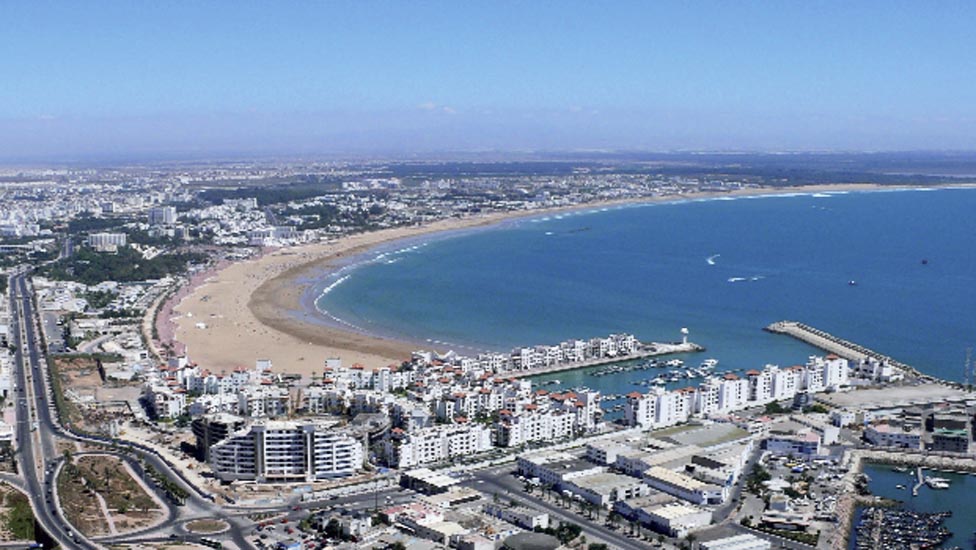
Extending over an area of 53,789 km2, or 7.6% of Moroccan territory, the Souss Massa region is home to two prefectures, four provinces, 154 rural communes and 21 municipalities. Its population is 2,676,847 inhabitants. The region has many natural resources, including fertile land, vast forest areas (argan, thuja, oak, etc.), fish reserves, attractive tourist sites and mining deposits (silver, manganese, barite, iron and gold).
The Souss-Massa region managed to drain nearly 1.8 billion Euros during the year 2017, an increase of 491% compared to the previous year; we are therefore already witnessing the start-up of 213 projects for the creation of 12,793 jobs. The region is drawing the lines of its economic positioning and programming several point-to-point studies for key sectors.
At the head of the locomotive, the tourism sector, which continues its dynamic at an increasing pace, and occupies first place in terms of investments committed, this is what emerges from the statistical data of the Regional Investment Center (CRI) Souss Massa. Firstly, the seaside resort of Taghazout which spreads over an area of 615 ha fronting a coastal strip of 4.5 km of beaches of exceptional beauty. With a series of very impressive projects.
This is the “Riu Tikida Argane Bay Taghazout” hotel, a 5* hotel complex with 500 rooms for more than 912 million DH (90 million euros) aimed at creating 357 direct jobs. Another 5* hotel with 205 keys will see the light of day under the “Hyatt Regency” brand, supported by the Madaef SA Company for 520 million DH, with 300 direct jobs at stake. Also in Taghazout Bay, the project to create a real estate development for tourism promotion (RIPT), carried out by the Sud Partners Company, for 400 million DH, generating 100 direct jobs.
the Company “Pickalbatros Morocco for Tourism and Investment” for its part obtained the construction of a 5* hotel with a capacity of 400 rooms for 665.5 million DH with more than 420 direct jobs in sight. Seven other components are on the program at the resort level: a Hilton hotel, a Marriott hotel, a tennis academy, a golf academy, an argan center, a beach club and a theme park for a total investment of 964 million DH which will allow the creation of 545 direct jobs.
Moreover, and in terms of tourist entertainment, the year 2017 was also marked by the validation of an amusement park in the Anza area. It is supported by the company “Agadir Delfin World” for a budget of 7.5 million DH and around twenty direct jobs in the long term.
Water desalination plant project: This mega-project, the first of its kind in Africa, is initiated by the Department of Agriculture at the request of farmers and their associations. The project, with a budget of 4.4 billion DH, is a model of public-private partnership and the result of a process of cooperation between the Department of Agriculture and the National Office of Electricity and Drinking Water to pool land resources and infrastructure. It aims to meet the irrigation needs in the Chtouka area and the drinking water of Greater Agadir. Scheduled for 2020, the commissioning of the desalination unit will provide 275,000 m3/day at a flow rate of 150,000 m3/day to cover drinking water needs, and a flow rate of 125,000 m3/day to meet irrigation water needs. Its installations will ultimately allow a total capacity of 400,000 m3/day.
The Palais des Congrès: This is a project which will require an overall investment of more than 1.4 billion dirhams and will be launched in two phases. The first concerns the construction of the convention center which will include a modular space that can accommodate more than 2,000 people with a 500-seat auditorium in addition to the business center converted into office platforms. As for the second phase, it concerns the creation of a leisure mall with 7 cinema rooms, a bowling alley and a Kids park in addition to a business park and a 5-star hotel with a capacity of 150 rooms, and 2 independent riads. The management of this establishment (Mariott City Center), which has already received the provisional “5 star” classification with a “business” clientele-oriented positioning, will be ensured by the American hotel group Marriott with which the investor had already signed an agreement. However, all the components will require 48 months to complete. Ultimately, the project will create around 700 direct permanent jobs and 2,000 indirect jobs
The Souss-Massa mega industrial project: It has the ambition to ultimately create 24,000 new jobs, in partnership with professional federations and private investors. And in terms of agro-industrial production, Souss-Massa will become a real platform for processing agricultural products intended for the local market and for export, mainly to the African continent.
Ecosystems: Furthermore, 500 million Euros of investment will be made in the infrastructure of the shipbuilding sector at the national level and the chemistry sector will receive personalized monitoring, for the development of the organic chemistry and green chemistry sectors. With new ecosystems that will be developed in emerging sectors such as industrial acceleration levers, automotive subcontracting, offshoring, leather, construction materials and plastics processing.
Such regional ambition boosted by adequate financial strength requires the implementation of five essential levers:
An Industrial Free Zone with an area of 300 hectares, 50 of which for the first tranche will be set up in the commune of D’rarga (Prefecture of Agadir Ida-Outanane) and will be called the « Souss-Massa export free zone » by bringing together 11 sectors: agro-food, chemicals-parachemistry, automobiles, aeronautics, renewable energies, textiles-leather, construction materials, plastics processing, naval industry, IMME and services relating to these activities.
Technopark: it is the result of a partnership with the Agadir region, the Souss Massa chamber of commerce and industry and the Technopark. The project will require 30 million dirhams, half of which is financed by the Souss-Massa regional council over the period 2018-2019 for participation in the construction and development of the building. The region and the chamber of commerce will provide a building which is currently under construction, and the Technopark management company will take care of the operation. The building meets certain prerequisites in terms of interior architecture and layout of the premises. It is a first to have a Technopark building designed from the ground up to house technological start-ups. The capacity in Agadir will be 80 companies present on site. It is planned to provide the same services as those that exist in Casablanca, Rabat and Tangier. But also to put technology at the service of the development of certain specificities of the region such as tourism, aquaculture or even local products. This future entrepreneurial hub, with an area of 10,000 m², will be located in the Tilila district, Bab El Madina, and is managed by the mixed-capital management company MITC (Morocco Information Technology Company) which manages all of the sites. CDG is 18% involved, the State is 33%. The rest are Moroccan private banks. This building will be intended for SMEs and start-ups in the ICT sector and will provide them with ready-to-use premises with support services. “For the first axis of regionalization, during the year 2019, we are counting on the opening of a fourth Technopark in Agadir intended to support the dynamic of entrepreneurship and innovation in the Southern region in accordance with the 2014-2020 industrial acceleration plan in the Souss-Massa region,” indicates Lamiae Benmakhlouf, general director of the MITC in a press release.
The City of Innovation: It will provide the region with a technological reception infrastructure, facilitating support for young leaders of innovative projects. The planned city will thus provide the region with a technological reception infrastructure, facilitating support for young people carrying out innovative projects. The platform will be set up within the Ibn Zohr University of Agadir. It will cover an area of 4,900 m² and will house, among other things, a creative center, a coworking space, offices for startups, a free BtoB space and offices for SMEs, clusters and researchers. The project will require 45 million dirhams of investment which will go towards the development and equipment of the City. This will constitute a structure for monitoring, prevention and the search for innovative solutions to problems linked to the Sustainable Development Goals and technological progress. Once on track, the project intends to promote North-South and South-South knowledge sharing and transfer, by housing an African R&D hub and position the region in relation to Morocco’s ambition towards Africa. It is also about promoting decentralized cooperation and scientific diplomacy and supporting the creation of innovative businesses through the incubation and valorization of research. La Cité is the result of the joint commitment of Ibn Zohr University and the Souss-Massa region in partnership with the ministries of National Education, Industry and the wilaya of the region.
The allocation of 50 million Euros from Industrial and Agricultural Development Funds to industrial projects in the Region; the private sector of the Souss-Massa Region plans to invest 50 million Euros in these industrial projects. Thanks to this new involvement of all stakeholders, the industrial projects which will be developed in the Souss-Massa region can be carried out by operators with a contribution limited to 20% of the amount of these projects. Indeed, another 20% will be supported by private investors in the region, an additional 20% will come from subsidies from the Industrial and Agricultural Development Funds. And the remaining 40% will be financed, under advantageous conditions, by the banking sector.
Thus on January 28, 2018, in Agadir, King Mohammed VI presided over the presentation ceremony of the regional version of the 2014-2020 Industrial Acceleration Plan in the Souss-Massa region and the signing of eight conventions and a protocol allowing, a great first in the kingdom, the implementation of the Industrial Acceleration Plan in this region as well as the realization of 11 industrial investments in this same region. It’s the royal kick-off.
Here are the agreements and signed protocol:
1-Convention for the variation in the Souss-Massa region of the automotive, leather, naval, chemical, plastics, construction materials and offshoring ecosystems.
2-Agreement to support the training needs of human resources in the industrial development strategy of the Souss-Massa region by 2020.
3-Convention for the establishment of a City of Innovation in the Souss-Massa region.
4-Convention for the planning, development, promotion, marketing and management of the Souss-Massa free zone.
5-Convention for the implementation of the development strategy for agri-food industries in the Souss-Massa region.
6-Agreement for financing the Agri-Food Industries Development Program.
7-Convention for the establishment of a Technopark in the Souss-Massa Region.
8-Agreement to support the establishment of a Private Fund for the development of investment in the Souss-Massa region.
9-Protocol for the realization of 11 industrial investments concerning four sectors of economic activity: construction materials, plastics processing, the paper and cardboard industry as well as Offshoring.
The first ecosystem, “Construction materials”, concerns three sectors. The “prefabricated” sector which consists of the creation of manufacturing units for prestressed concrete products and prefabricated concrete products, entrusted to “Sadet”, “Vetcam”, “Daoud Building” and “Sicmaco”. “Cement and Waste Recovery” is a sector which involves the establishment of a platform for the energy recovery of household waste through the installation of a RDF (Fuel Substitute Fuel) production plant, entrusted to Ciment du Maroc and Lafarge Holcim. This also concerns the “Briqueterie” sector, whose project to create a terracotta brick manufacturing unit is supported by “Briqueterie d’Atlantique”.
The second ecosystem relates to plastics processing, which includes the packaging and plasticulture sectors. The Packaging sector is concerned by the establishment, by “SGIPS”, of a manufacturing unit for agricultural trays and crates, while that of plasticulture includes the creation of units for the manufacturing of irrigation tubes for agriculture (Amal Bandes Plastiques) and the manufacturing of irrigation tubes and mulch films Signatory (Fellah Manufacturing).
The third ecosystem “Paper and cardboard industry”, aimed at setting up a collection center for recyclable paper and cardboard and extending the corrugated cardboard unit in Agadir, is supported by “GHARB Papier et Carton (GPC)”.
Regarding the “Offshoring” ecosystem, which concerns the CRM (Customer Relationship Management) sector, it consists of the creation of a new customer relations center entrusted to “Webhelp Agadir” whose general director is Philippe Broutin, who has already fulfilled part of the commitment thanks to an investment of 25 million dirhams by creating 300 jobs out of the 950 planned between 2017 and 2020.
Ultimately, through this vast Souss-Massa industrial project launched on January 28, 2018 in the city of Agadir, the Moroccan Sovereign implemented the Industrial Acceleration Plan corresponding to balanced, inclusive territorial development dedicated to the specificities of the region. The aim is therefore to energize this region as an economic hub capable of creating employment from the potential, wealth and productive assets of the local economy through integrated, inclusive and sustained growth throughout the entire territory. The exemplary success of this future economic miracle of Souss Massa will then serve as a road map for the other regions of Morocco and by extension Africa.
Emergence of major projects
The Port of Agadir: With its 3,000,000 tons of goods, 75,000 passengers, 140,000 tons of fish and 45,000 containers per year, the Port of Agadir makes a solid contribution to the national economic development of Morocco. Annual traffic is expected to increase to 16 million tonnes by 2030. The National Ports Agency (ANP) plans an envelope of 2.8 billion dirhams for the expansion of port infrastructure. In this sense, it is expected to focus once again on a goods reception capacity that meets the expectations of large global investors and on the connectivity of the port with the national road network with direct routes to ensure ideal timing for the delivery of materials.
The Abdelmoumen pumped energy transfer station (Step) project: It will require an investment of 3.8 billion dirhams and consists of storing energy in hydraulic form and will produce 350 MW. Located 70 km from Agadir, this project will be carried out over an area of six hectares in the commune of Bigoudine, in the province of Taroudant. It is part of the development and integration plan for renewable energies in Morocco. Lasting 48 months, the project started in April of this year and employs 200 direct and indirect jobs.
The Halieutis Plan: It focuses in its vision of promoting the sector on three components: sustainability, performance and competitiveness. Axes broken down into 16 projects. Among the projects expected in the region, I cite the project to create aquaculture zones, i.e. twenty-three aquaculture projects which will be launched in the Souss-Massa region, for an investment of 400 million dirhams targeting 620 direct jobs.
The Agropole Souss Massa: It spreads over an area of 55 ha, to be built in 3 phases. The first tranche totals 22 transferable ha. The investment reached 260 million DH, including 120 million DH for off-site. 10,000 jobs, including 6,500 direct jobs will be created. The Region is considered the leading fruit and citrus growing region in the country with a regional GDP of 17.3% / national of 9%, and a total of 451,165 ha of cultivated land including 106,664 ha equipped with a drip irrigation system. The promotion of regional agricultural products will take on another dimension with the Agropole of Agadir. A 75-hectare regional platform of reference for the processing, marketing and distribution of agricultural products, an agro-industrial activity zone, a logistics and services zone, commercial and distribution platforms, but also a reception center for services to businesses and individuals with a “Qualipole”, laboratory, research and control center and a training center.
Crafts: A project is underway to create a specific label for craft products from the Souss-Massa region with a view to promoting the quality of these products through recognition of the specificities of their geographical origins. The labeling will thus enable the region’s artisans to improve the quality of their products, facilitate their marketing on the market and promote the authentic traditional heritage of the region.
Rural action: An envelope of 45.7 million dirhams was allocated to the AREP (Regional Project Execution Agency) under this exercise, for the construction and equipment of hospitals and care centers in addition to the construction of primary education classes and pathways in rural areas. Regarding the progress of projects launched in 2017, as part of the program to reduce spatial and territorial disparities, it fluctuates between 60 and 100%.
Air: The Souss Massa region grants a subsidy of 24 million dhs to Air Arabya to open 3 new lines Rabat, Fez and Tangier and remains awaiting an agreement to be signed with RAM for better prices on the Casablanca Agadir airline. The increase in attendance is therefore closely linked to price. We therefore expect better scores on the Casablanca-Agadir line where the one-way trip will be charged 550 DH, while it could reach 1000 DH during the high season.
Cultural heritage: the Souss-Massa-Draa Region aims to be a rich mosaic of cultural heritage, pointing out certain dangers which threaten this wealth, notably the legal deficit in this area, the effects of galloping globalization, or even certain human actions. The preservation and enhancement of this heritage necessarily involves its in-depth knowledge and mastery, on the path to the development of clear visions so that it can be at the service of sustainable development.
Agadir – Dakhla road: 8.5 billion dirhams for a 1055 km expressway on the Tiznit-Laayoune-Dakhla road. This major structuring project, which will have positive repercussions on the different aspects of economic and social life, also has a deep sentimental dimension because by thus linking the north and the south of Morocco, it gives an idea of the strength, both economic and patriotic, of the links between the different regions of the Kingdom.
“Kitea Géant” project: This project validated during the past year and carried out by the Company “K Foncière” SARL will be located near the Grand Stade. It will cover a total area of 55,000 m2, and will require a budget of 140 million DH. In total, the new structure will allow the creation of 350 permanent and 180 temporary jobs.
Health tourism: a cardiology center from the company “Moroccan Heart Care” for a budget of 40 million DH; a clinic specializing in reconstructive surgery, serious burns and aesthetics run by the SA2 Company over an area of 9,986 m2, with a capacity of 24 rooms and 6 suites estimated at 38 million DH. A clinic specializing in radiotherapy and plastic surgery under the name “Clinique des Roses” is also planned. Its capacity is 60 beds for an amount of 60 million DH. And finally, a training academy in health professions to be carried out on an area of 4.23 m2 supported by the Company “Agadir Health Center”, for an investment of 41.5 million DH and allowing the creation of 40 direct jobs.
It is clear that the economic potential and investment opportunities of Souss-Massa no longer need to be demonstrated. The region has adopted a 2022 Regional Development Plan (PDR) with a budget of 24.5 billion DH and remains undoubtedly one of the most successful and promising regions of the kingdom, thanks to its contribution of 7.7% of national wealth, 44% of fruit and vegetable exports and 50% of national fish production. The Souss Massa version of the Industrial Acceleration Plan presents, as we can see, the beginnings which lead us to believe that the regional economic miracle is now within reach.
source: financialafrik.com