
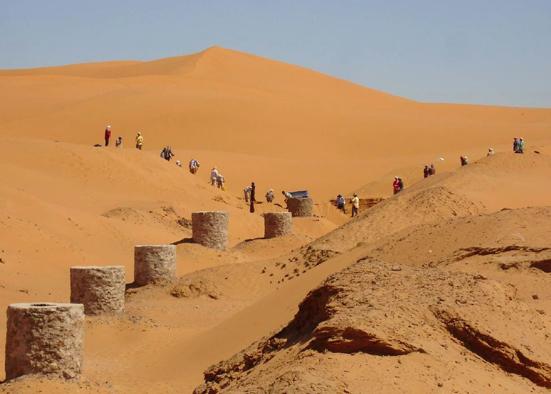
What if a return to ancient irrigation techniques was the response to current water stress? At SIAM 2023, “khettaras”, a technique used in Morocco for more than a millennium, is presented as a solution for sustainable agriculture, but also a way to revive tourism in oasis areas. “Our objective is to raise awareness about the usefulness of khettaras in the current context of scarcity of water resources. We are convinced, and it is scientifically proven, that khettaras can be a response to current challenges for sustainable agriculture that adapts to climate change. These words are from Lalla Bedra Saoud Alaoui, president of the Miftah Essaad Foundation for the Intangible Capital of Morocco. Present at SIAM in the Drâa-Tafilalet region stand, this foundation is carrying out intense lobbying for the restoration of the khettaras of Morocco. The khettara is a system of underground water conduits, dug by humans, for irrigation and domestic use, in oasis areas. There are hundreds of them in at least 5 regions of Morocco. Khettara has been used for millennia by several civilizations around the world, such as in Morocco since the time of the Almoravids in the 11th century. This ancestral technique has always played a leading role in the continuity of the agricultural system in Morocco. “Khettaras are a solution for water preservation both in Morocco and in other countries. It is therefore essential to preserve them, rehabilitate them, restore them and highlight them,” argues Lalla Bedra Saoud Alaoui. UNESCO and tourism In this regard, the Ministry of Agriculture is currently conducting a census of the khettaras of Morocco, through an international research office. The final objective is to include them in the UNESCO universal heritage, after their successful entry into the national heritage list in December 2020. In 2021, the International Water Commission, under the auspices of the United Nations, listed the khettaras as a “source of irrigation and drainage”. And in July 2022, they were included in the heritage list of the Islamic World Educational, Scientific and Cultural Organization (ICESCO). Beyond these aspects linked to heritage and the need to make them a tool for sustainable agriculture that adapts to climate change and water stress, khettaras are considered a real opportunity for the national tourism sector, particularly in oasis regions. “The know-how surrounding khettaras deserves to be promoted among tourists who visit our country. And it is obvious that this could inspire throughout the world,” we firmly believe at the Miftah Essaad Foundation for the Intangible Capital of Morocco.
source: leseco.ma