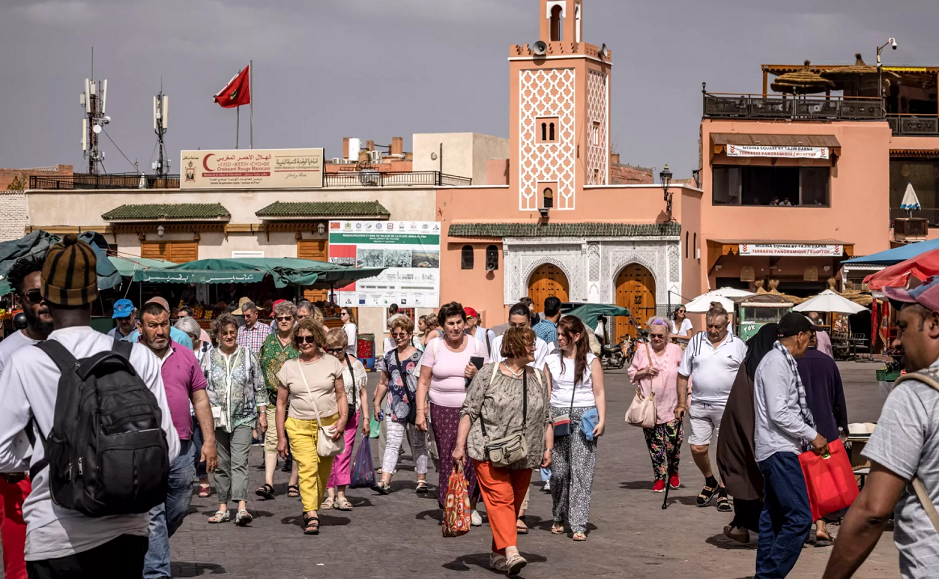

You can share an article by clicking on the share icons at the top right of it. The total or partial reproduction of an article, without the prior written authorization of Le Monde, is strictly prohibited. For more information, consult our general conditions of sale. For any authorization request, contact syndication@lemonde.fr. As a subscriber, you can gift up to five items per month to one of your loved ones using the “Gift an Item” feature. https://www.lemonde.fr/afrique/article/2023/09/24/au-maroc-l-impact-contraste-du-seisme-sur-le-tourisme_6190809_3212.html If he admits to having lived “three complicated days” after the earthquake, which occurred Friday September 8 and which left nearly 3,000 dead and more than 5,600 injured, according to a latest official report, Hamid Bentahar, president of the national tourism confederation in Morocco, also director of operations for the Accor group in the kingdom, is reassuring: “Cancellations have not been as numerous as feared and the planes landing in Marrakech are full. » A relief shared by the secretary general of the regional association of the hotel industry, Mustapha Amalik, also owner of a forty-room boutique hotel. “No cancellations, only postponements,” he specifies, adding that the airport is operating at full capacity with “more than four hundred flights per week.” Same observation at Club Med de la Palmeraie, a heavyweight in the sector with three hundred rooms. “Our occupancy rate fell by four points over the first four weeks of October, but two thirds of the cancellations are postponements,” notes Thierry Orsoni, the group’s director of communications and institutional relations. No closed hotels in Marrakech Located around a hundred kilometers from the epicenter, Marrakech was only very partially affected by the earthquake. The authorities recorded eighteen deaths and the damage, limited, was confined to the old medina. “It is especially in this area, which is home to many riads, that the cancellations were the most significant,” underlines Samuel Roure. The president of the association of guest houses of Marrakech, Essaouira and Ouarzazate, which brings together 2,000 establishments, puts the cancellation rate “between 40 and 50%” in September and forecasts “25%” for October and November, even if he counts very few closures: “The damage is limited, the impact is mainly economic. Customers prefer to wait before deciding to come. » Read also: Rebuilding after the earthquake in Morocco: “Regulations have made concrete a constituent element of modernity, we must get away from this vision” Add to your selections Visiting the old medina of Marrakech on Thursday, the Minister of Tourism, Fatim-Zahra Ammor, wanted to be confident: “We would like to reassure our partners and future tourists about the stable situation in Marrakech. » No hotel has closed in the city, but the Covid-19 crisis is still on everyone’s minds. In 2020 and 2021, Marrakech lost 80% of its visitors, while 500,000 people make a living from tourism in the prefecture. Since the earthquake, regaining trust has become the leitmotif of tourism professionals. “Don’t panic”, nuance Zoubir Bouhoute. This independent consultant, former president of the Ouarzazate provincial tourism council, has made his calculations: the month of September records “10 to 15%” of canceled reservations in Marrakech, or “between 70,000 and 100,000 fewer nights.” The cancellations should fade in October and November, but it is in the rural world, he warns, that the situation is more serious: “In the short term, there will be no recovery in these territories. » Read also: In Morocco, in the High Atlas, agriculture to rebuild after the earthquake Add to your selections In the province of Al Haouz, which records 60% of deaths, a large number of establishments have closed. This is the case of Terres d’Amanar, which peaks at an altitude of 1,200 meters in the High Atlas massif. Abdellatif Abouelghanaim, the manager of accommodation and reservations, points out numerous damages in the rooms and the restaurant: “We do not know when we will reopen, we are still waiting for the expert to come. » An hour away, the situation is worse. In the Imlil valley, backed by Toubkal, the highest peak in North Africa, “everything is closed”, according to him.
source: lemonde.fr