
Astronomy in Morocco has always been a source of inspiration and curiosity. It gives rise to a rich astronomical tradition that extends from Berber ancestors to scholars of the modern era. Today, Morocco, kingdom of stars, continues to play a significant role in the field of astronomy and astrophysics. It does this through a unique combination of historical heritage and contemporary initiatives.
A Celestial Heritage: The History of Moroccan Astronomy Moroccan astronomy has its roots anchored in the thousand-year history of the country. It offers a fascinating panorama of how people turned their gaze to the sky, seeking to understand the mysteries of the universe. From antiquity to the modern era, Morocco has contributed significantly to astronomy, combining observation, religion and science.
Historical Foundations Interest in astronomy in Morocco dates back to ancient times. Where the first civilizations used the stars to guide themselves, measure time and plan their agricultural activities. Megalithic sites and rock engravings in different regions of Morocco bear witness to this early fascination with the starry sky.
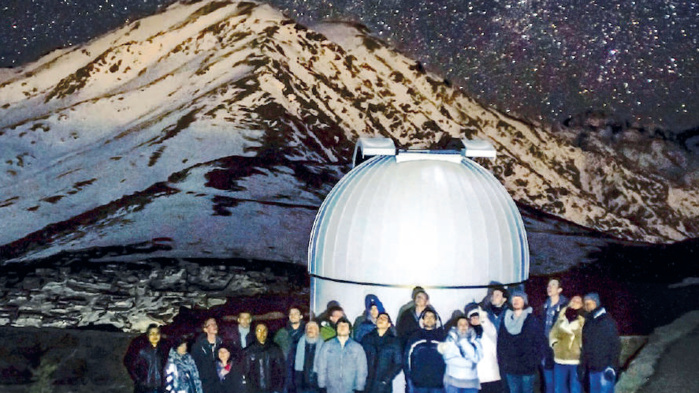
Megalithic alignments: Like that of M’zora, these stone structures suggest a use for observing the stars and marking the solstices. Lunar calendars: The Berbers developed calendars based on lunar cycles. They are essential for religious ceremonies and agricultural activities. The Golden Age and its Legacy The golden age of Moroccan astronomy is part of the broader context of the scientific renaissance. The latter crossed the medieval Muslim world. In Morocco, scholars like Ibn Battuta and Al-Idrisi explored and documented their knowledge of the world, including precise astronomical observations. Centers of learning: Schools and universities, such as Al Quaraouiyine University in Fez, have played a crucial role in the preservation and transmission of astronomical knowledge. They attracted scholars from the Islamic world, thus promoting a rich exchange of discoveries and innovations. Scientific contributions: Moroccan astronomers have contributed to the development of observation instruments and the improvement of navigation techniques. Their work served religious needs. There is the precise determination of prayer times and the direction of the Qibla, but also helped the sailors and explorers of the time. Towards the Frontiers of the Universe: Astronomy and Astrophysics Today In the wake of its rich astronomical heritage, Morocco positions itself today as a promising player in the field of contemporary astronomy and astrophysics. Thanks to a combination of ambitious initiatives, modern infrastructure and international collaborations, the country is now exploring the far reaches of the universe with a renewed and innovative perspective. Current Initiatives and Infrastructure Morocco has invested in cutting-edge astronomical infrastructure. The Kingdom has launched several initiatives aimed at promoting research and education in the field of astronomy: Astronomical Observatories: The country is now home to several observatories equipped with advanced telescopes. They allow astronomers to conduct celestial research and study cosmic phenomena from Moroccan soil. The Oukaimeden Observatory, for example, plays a key role in national and international astronomical research. Educational programs: Moroccan universities and institutions offer courses in astronomy and astrophysics. They train the next generation of scientists there. These programs are often supported by workshops, conferences and public events. The latter aiming to arouse interest in astronomy among the general public. Research Projects and International Collaborations Morocco engages in ambitious research projects and collaborates closely with the international scientific community, thus affirming its role in global astronomy: Participation in international projects: Morocco is involved in several international collaborations, such as the Square Kilometer Array (SKA) project, which aims to build the largest radio telescope in the world. By participating in such projects, Morocco contributes significantly to research in astrophysics and to the understanding of the universe. Studies and discoveries: Moroccan astronomers work on a variety of research projects, from observing variable stars to studying distant galaxies and cosmic phenomena, such as black holes and gravitational waves. This research contributes to enriching our knowledge of the universe. The current dynamism of astrophysics and astronomy in Morocco reflects not only the country’s commitment to science and technology but also its aspiration to play a leading role in the astronomical discoveries of tomorrow. By continuing on this path, Morocco is not only perpetuating its astronomical heritage; he reinvents it, projecting the kingdom to the forefront of space exploration and cosmic research.
source: discoverymorocco.net