
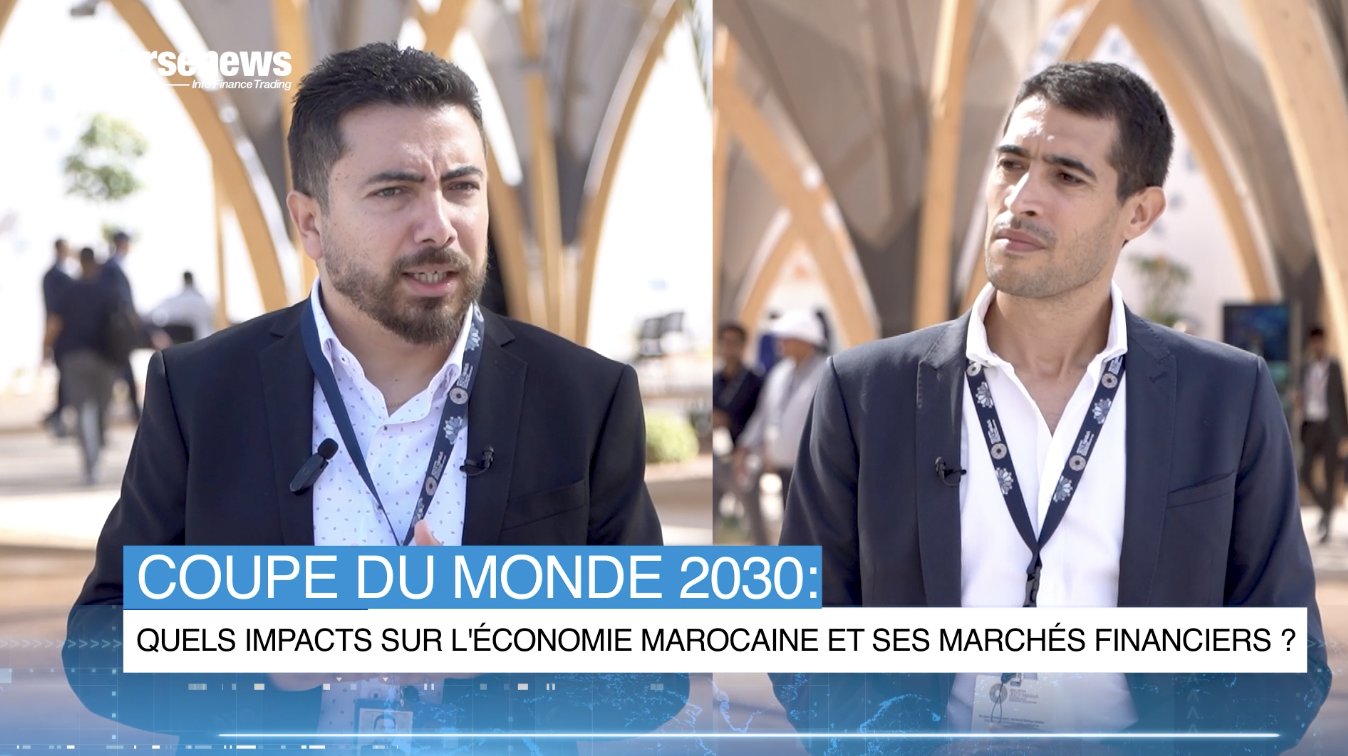
Morocco will host some World Cup matches in 2030. This event will have a considerable impact on the development of the Kingdom at all levels. To discuss it, Tahar Zerrari, deputy director of Sogecapital Gestion, and Karim El Hnot, deputy director of investment banking at Société Générale Maroc, who published a prospective study in 2022 on the potential impact of this event on Morocco.
On Wednesday, October 4, 2023, a press release from the Royal Palace announced that “the FIFA executive committee unanimously chose the Morocco-Spain-Portugal file as the sole candidate to host the Football World Cup in 2030. Good news for Moroccans who have been waiting for this announcement for a long time. But what will be the cost and above all the impact of this event on the development of Morocco? Our two experts who had already worked on the subject in 2022 estimate that the financial envelope to be provisioned should be between 50 and 70 billion dirhams. Behind these figures, “there is a scientific approach which consisted of a study of the existing situation, a comparison, an assessment of the latest projections established when Morocco bid for 2026,” explains Tahar Zerrari. This colossal sum, but reasonable according to experts given Morocco’s ambitions, is justified in particular by the cost of building and upgrading stadiums, training centers, hotel infrastructure and even transport. Because the Kingdom, which will host the event without formally organizing it, will receive little direct revenue such as ticketing which is captured by FIFA. The challenge is therefore to prepare an appropriate framework to benefit from the immense indirect benefits. “Analyzing a World Cup solely through an economic prism is nonsense. There is the image, the influence, the diversification that such an event brings,” underlines Karim El Hnot, specifying that the host country will only share television advertising revenue with FIFA. A strengthened banking sector and an economic boost Driven by the major works to come, the national economy should logically experience a boost beneficial to several sectors. Project financing will replenish bank liquidity while the increase in activity will stimulate credit granted. “The market is rarely wrong, especially when it acts in unison in a unanimous manner,” underlines Tahar Zerrari. The rise in construction and hotel values on the stock market demonstrates that this movement is in working order.” The Kingdom will, however, have to avoid the dreaded pitfall of “white elephants”, these pharaonic infrastructures doomed to underexploitation once the event is over. This is one of the major challenges identified by experts. “We have to invest in a logical way,” insists Karim El Hnot, citing the example of a large Brazilian stadium transformed into a simple parking lot after the 2014 World Cup. The Casablanca project, which aims to build the largest arena in the world, will have to be part of a true “sports city” to remain sustainable. A vision of long-term development Beyond the immediate economic spotlight, estimated between 0.7 and 1% of GDP according to the IMF for the case of Qatar, the two experts see in this event a lever for the realization of the long-term development vision of the Kingdom. “This ambition fits with the Moroccan vision over the next 30 or 40 years of upgrading sports infrastructure, but also transport, accommodation and industrial infrastructure,” considers Tahar Zerrari. While meeting certain planning and sizing challenges to be well anticipated, the “Paroles d’Experts” program reflects Morocco’s ambition to properly host a global event with strong added value in different key sectors of its economy. A formidable launching pad towards development, provided that the risks are controlled and all the opportunities are intelligently exploited.