

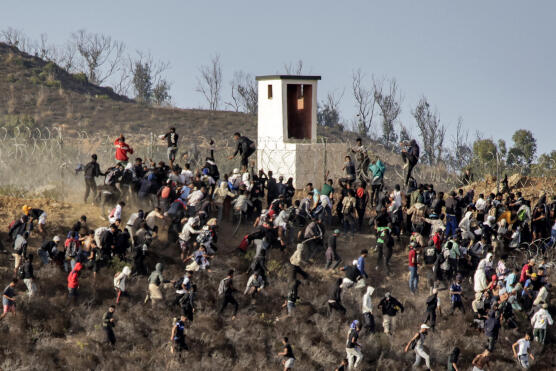
After that on Sunday, a new massive attempt to cross the border would be planned for September 30. Planned on social networks, these forced crossings mainly involve Moroccan nationals, whereas until now they were the work of sub-Saharan migrants.
You can share an article by clicking on the share icons at the top right of it. The total or partial reproduction of an article, without the prior written authorization of Le Monde, is strictly prohibited. For more information, consult our general conditions of sale. For any authorization request, contact syndication@lemonde.fr. As a subscriber, you can gift up to five items per month to one of your loved ones using the “Gift an Item” feature. https://www.lemonde.fr/afrique/article/2024/09/19/l-enclave-Espagnee-de-ceuta-sous-la-pression-de-migrants-marocains-souhaitant-rejoindre-l-europe_6324517_3212.html The situation is exceptional. Since Wednesday September 11, around 4,000 Moroccans – including nearly one hundred and fifty minors – suspected of having wanted to illegally enter the Spanish enclave of Ceuta have been arrested or turned back, according to a security source, while messages circulating on social networks called for them to join this territory on Sunday September 15. If the police pushed back hundreds of people gathered near the border that day, most were arrested beforehand, in the surrounding towns of M’diq, Tetouan or Tangier, say community activists. Officially, no one managed to cross to the Spanish side, but, according to testimonies, around twenty individuals from the town of El-Jadida, 500 kilometers to the south, succeeded. The significant presence of Moroccan citizens raises questions, while these attempts at forced entry have until now involved people from sub-Saharan Africa. On May 17 and 18, 2021, between 8,000 and 12,000 Moroccans, according to estimates, entered Ceuta amid a diplomatic crisis between Rabat and Madrid; Morocco then criticized Spain for welcoming the leader of the Sahrawi separatists, Brahim Ghali, to its soil for treatment. “But these departures had benefited from the tacit complicity of the Moroccan authorities,” says researcher Ali Zoubeidi, specializing in migration issues, who is conducting an on-site study.
Nothing comparable today, assures the latter, who sees in the episode of September 15 the sign of a new mode of operation: “It is no longer clandestinity in small groups, sometimes with the help of smugglers, as the Moroccans were used to doing. do, but a massive mobilization and an open confrontation with the police. »