
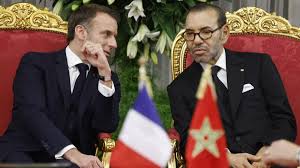
Emmanuel Macron invites Mohammed VI to the Agricultural Show amid tensions around the free trade agreement with Morocco

This invitation, to which the Moroccan sovereign has not yet responded, comes as the main French farmers’ unions denounce “unfair competition” from Moroccan tomatoes.
Will Mohammed VI go to the International Agricultural Show with Emmanuel Macron? According to our information, the French president invited the King of Morocco to attend the annual high mass of the agricultural world which will take place in Paris from February 22 to March 2. The monarch has not yet responded to the invitation from the Elysée, but his official trip, if confirmed, would be his first in France since 2018.
You can share an article by clicking on the share icons at the top right of it. The total or partial reproduction of an article, without the prior written authorization of Le Monde, is strictly prohibited. For more information, consult our general conditions of sale. For any authorization request, contact syndication@lemonde.fr. As a subscriber, you can gift up to five items per month to one of your loved ones using the “Gift an Item” feature. https://www.lemonde.fr/afrique/article/2025/02/12/emmanuel-macron-invite-mohammed-vi-au-salon-de-l-agriculture-sur-fond-de-tensions-autour-de-l-accord-de-libre-echange-avec-le-maroc_6543436_3212.html The choice of the Agricultural Show is not trivial. For the first time, the event will highlight a country, in this case Morocco. A decision which “reflects the importance of the agricultural partnerships which bind us”, explain the organizers. However, it is difficult not to see it as an extension of the bilateral rapprochement concluded in 2024 at the end of a two-stage diplomatic sequence: the recognition by Emmanuel Macron of Morocco’s sovereignty over Western Sahara, in July, then the visit of the French president to Rabat, in October. In Paris, a large Moroccan delegation is expected, while agricultural trade on both sides has surged, driven by the growth of French cereal exports and the increase in Moroccan exports of fruits and vegetables. The renewed confidence between the two countries could, however, suffer from the new balance of union power in France. With, in the background, a surge in protest against the agricultural agreement between the European Union (EU) and Morocco. Symbol of the “unfair competition” of which French farmers say they are victims: the Moroccan cherry tomato, exempt from customs duties subject to quotas. Read also | In Morocco, tomato producers assure that French farmers are targeting the wrong target. On this issue, the areas of friction on both sides of the Mediterranean are not new. When Moroccan producers claim to respect European standards and want to be competitive, their French counterparts criticize them for the use of insecticides banned in the EU and the low cost of their labor, which would result in cut prices in mass distribution. Sold in France for 0.99 euros, the 250 gram tray of elongated cherry tomatoes produced in the region of Agadir, in the south of Morocco, or in that of Dakhla, in Western Sahara, crystallizes all the tensions. Punch operations The exasperation of French farmers peaked in 2024. Thousands of Moroccan tomatoes were then dumped on the roads and supermarket parking lots. On the front line of these punch operations, the Rural Coordination achieved a historic breakthrough in the chambers of agriculture, suggesting a stiffening of French union positions. At the Saint-Charles International market in Per Pignan, where Moroccan tomatoes transit, alerts have been issued in recent days in anticipation of possible retaliatory actions. To this anger, the score of the National Rally (RN) in the last legislative elections, which made the party chaired by Jordan Bardella the first political group in the Palais-Bourbon, now offers a political outlet. Without being at the origin, the far-right formation maintains close links with the Rural Coordination. Among union supporters, 47% of those surveyed said they wanted to vote for the RN in the European election in June 2024, according to the Sciences Po Political Research Center (Cevipof). And many RN deputies in rural areas have made the denunciation of free trade agreements their hobby horse. See also | How Morocco exports, via its tomatoes, the water it will soon run out of: video report on an ecological disaster Among them, Hélène Laporte, elected official for Lot-et-Garonne. This stronghold of Rural Coordination is home, after Bouches-du-Rhône, to the largest French tomato crops. Recently appointed head of the France-Morocco friendship group in the National Assembly, the RN deputy has repeated in recent months that she wants to “initiate a process of reviewing the agreements”. “I am thinking in particular of the one which links us to Morocco and which provides for exemptions from customs duties on the importation of tomatoes,” she declared in the Hemicycle on January 15. The subject was discussed during a meeting between Hélène Laporte and the Moroccan ambassador to France, Samira Sitaïl, on February 3 in Paris. Officially, Rabat’s position is to stick to the agreement signed with Brussels. “We do not want Moroccan farmers to be held responsible for internal problems in France or the EU,” indicates a Moroccan source. “Protectionist hints” Although the French government has not issued any signal in favor of its renegotiation, the scarecrow of a rethinking of the agreement is ready to be stirred up on the Moroccan side. Where it is made known that the renegotiation, if it takes place, will have to cover all the products concerned. At the risk of harming the interests of the big winners from free trade between the two countries: French cereal growers, who provided 45% of cereal imports to Morocco in 2022. Stay informed Follow us on WhatsApp Receive most of the African news on WhatsApp with the “World Africa” channel Join This shows how the comments made by the most media-oriented of them, Arnaud Rousseau, were not to the taste of professionals Moroccans. Before the Economic Affairs Committee of the National Assembly, on September 18, 2024, the number one of the National Federation of Farmers’ Unions (FNSEA) affirmed his “ambition to re-discuss the agreement” with Rabat. The chairman of the board of directors of Avril Gestion, the general shareholder of the Avril group (formerly Sofiproteol), owner of Lesieur Cristal in Morocco, has until now been considered a bulwark against the attacks of the most radical farmers.