
The objective of Vision 2020 is to double the size of the sector and the accommodation capacity, with the creation of 200,000 new beds. This new reception capacity should make it possible to double tourist arrivals (from Europe and emerging countries). 470,000 new direct jobs will be created throughout the national territory (1 million by 2020). Tourism revenue is expected to reach 140 billion dirhams in 2020 (a cumulative amount of 1,000 billion). Vision 2020 also plans to democratize tourism in the country and triple trips made by residents.
Generalized and coherent territorial planning
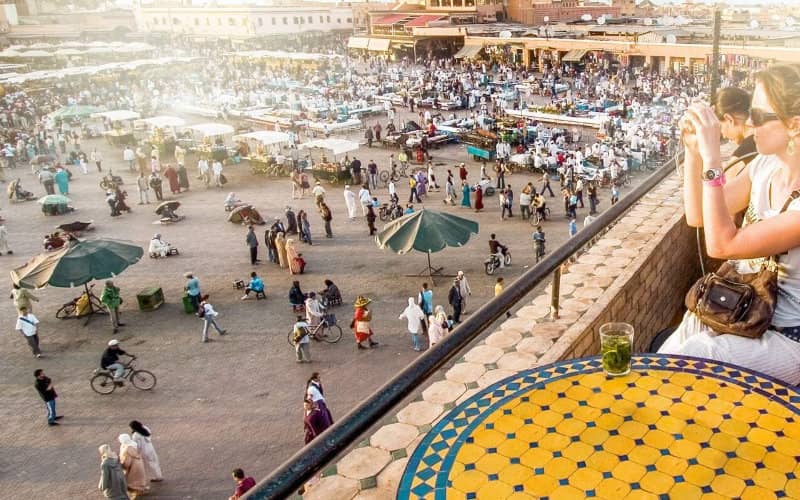
Today, tourism in Morocco is largely concentrated on two destinations: Marrakech and Agadir, which account for more than half of international overnight stays. This geographical concentration does not allow us to highlight all of Morocco’s potential. This is why a new planning and development policy has been launched. Eight territories were thus created in a logic of coherence. The objective is to give them international visibility and help them achieve full destination status.
Two territories have been defined on the Atlantic and Mediterranean coast:
• “Souss-Sahara Atlantique”, brings together the sites of Agadir (including the hinterland), Laâyoune and Guelmim;
• “Mediterranean Morocco”, which brings together the sites of Saïdia, Marchica and Cala Iris.
Four other territories have been positioned on a mixed, cultural and seaside offer:
• “Marrakech Atlantique”, anchored on the sites of Marrakech, Toubkal and Essaouira;
• “Morocco Center” is the destination for travel to the sources of culture and history and well-being, thanks to a strong complementarity between the sites of Fez, Meknes and Ifrane ;
• “North Cape” bringing together the sites of Tangier, Tetouan, Chefchaouen, Asilah and Larache;
• “Central Atlantic”, includes Casablanca, Rabat and El Jadida.
Finally, two territories are destined to become Morocco’s showcases in terms of sustainable development:
• “Great South Atlantic”, centered around the exceptional site of Dakhla;
• “Atlas and Valleys”, anchored on Ouarzazate, the valleys and oases, as well as the High Atlas.
A new institutional plan
Several structures have been created to ensure the harmonious management of the new tourist economy. The High Authority for Tourism is a national steering body, bringing together, within the framework of a partnership, the State, the regions and the private sector. Its mission is to ensure the implementation of the 2020 vision and to strengthen the institutional legitimacy of tourism. Tourism development agencies are, for their part, gradually created in the 8 tourist territories to guarantee the success of territorial strategies and regional tourism policy.
Six flagship programs
Six structuring programs have been defined around seaside culture and nature. These programs favor sustainable tourism and focus on high value-added niches.
• Azur 2020 focused on the seaside offer;
• Eco/Sustainable development, aiming to promote natural and rural resources while preserving them;
• Heritage & Heritage whose objective is to promote the cultural identity of Morocco;
• Animation, Sports & leisure which aims to create a varied entertainment offer which complements the basic tourist infrastructure;
• Niches with high added value in relation to business tourism, well-being and health;
• “Biladi” internal tourism which will make it possible to meet the expectations of Moroccans by offering them a suitable product.
Vision 2020 also provides for a National Program for Innovation and Tourist Competitiveness structured around three main axes:
• specific support for small and medium-sized tourism businesses;
• support for reference networks across the entire tourism value chain;
• improving the supervision of tourist activity through regulatory reform.
An integrated approach in favor of sustainable tourism
International tourists are increasingly aware of sustainable tourism, as indicated by the proliferation of labels and initiatives in the field. At the dawn of its tourism development, Morocco therefore has a unique opportunity to adopt a Moroccan model of sustainable tourism which could constitute a decisive competitive advantage. To support the deployment of the sustainable development component of Vision 2020, an integrated system will be put in place. It includes specific tools as well as evaluation and monitoring indicators. The system will thus make it possible to better apply sustainability criteria in regulatory standards and to put in place financial mechanisms to support the development of ecoterritories.
These actions will be supplemented by a marketing strategy and managed by the Sustainable Tourism Commission, an entity of the High Authority of Tourism.
Strong investment dynamics
To promote access to financial resources, the State created the Moroccan Tourism Development Fund (FMDT). Through a structuring approach, this fund will help build investor confidence and give impetus to the major projects supported by Vision 2020. At the same time, bonuses will be put in place to support tourism investment and direct it towards the least developed territories, as well as towards new development opportunities.
With regard to transport, the ONMT (Moroccan National Tourist Office) and the ADT (Tourist Development Agencies) will deploy specific strategies in order to support air service and increase the attractiveness of tourist areas.
In each territory, training centers of excellence will be created in order to guarantee the match between the training offer and the expectations of the labor market. These centers will be the result of a partnership between the public and private sectors.
portailsudmaroc.com