
BERKACH ABDELAZIZ
The General Assembly also elected five new members to the organization’s executive committee: a vice-president for Asia, as well as delegates representing Africa, Asia and Europe, for a three-year term.
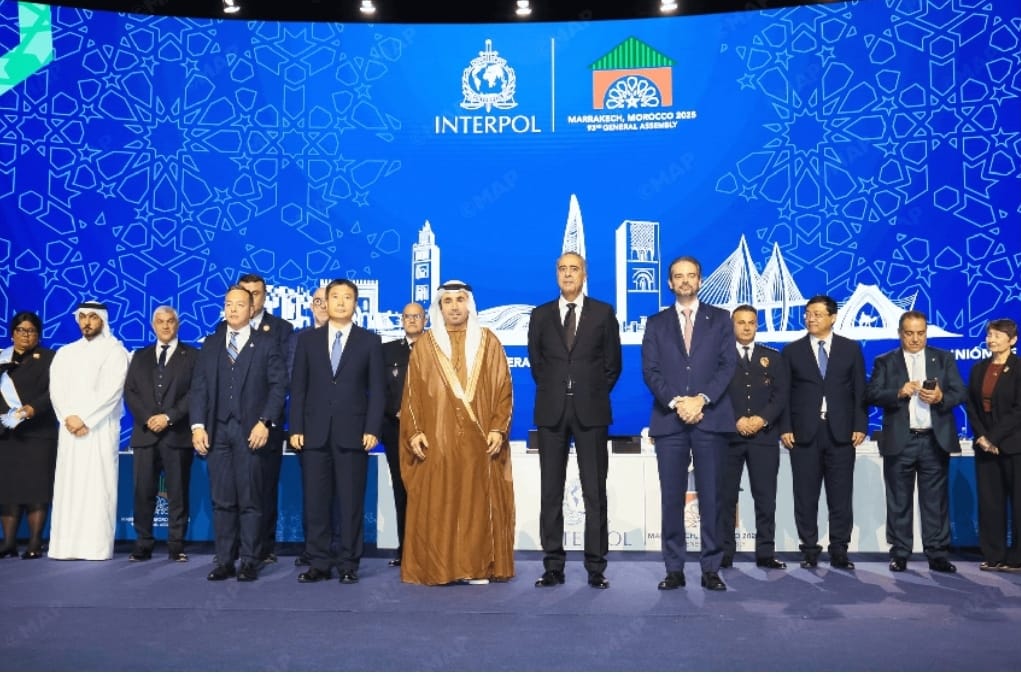
During the closing session, the announcement was made that Hong Kong/China will host the next session of the General Assembly in 2026. On this occasion, the Director General of National Security and Territorial Surveillance, Abdellatif Hammouchi, officially handed over the Interpol flag to the representatives of Hong Kong/China, in the presence of outgoing President Ahmed Nasser Al-Raisi, President-elect Luca Filippi, Secretary General of Interpol Valdecy Urquiza, as well as members of the executive committee.
Also attended the closing session: the Secretary General of the Council of Arab Ministers of the Interior, Mohammed Ben Ali Koman, the Minister of Foreign Affairs, African Cooperation and Moroccans Abroad, Nasser Bourita, the Minister Delegate in charge of the Budget to the Minister of Economy and Finance, Fouzi Lekjaa, the Commander of the Royal Gendarmerie, Lieutenant General Mohamed Haramou, the Director General of Studies and Documentation, Mohamed Yassine Mansouri, as well as the Wali of the Marrakech-Safi region, Khattib El Hebil.
The Interpol General Assembly, considered the largest global gathering of leaders of law enforcement services, constitutes an opportunity for member countries to establish partnerships and exchange their experiences. Meeting annually, the Assembly examines the main trends linked to crime and security challenges on a global scale.
It adopts decisions relating to general policies, means of international cooperation, working methods, financial resources and action programs, through resolutions approved by the Member States.
It should be recalled that Interpol, founded in 1923, is an international criminal police organization whose objective The main objective is to support national capacities and strengthen the exchange of information and expertise between the security services of the 196 member countries, in order to deal with transnational crimes and various types of security threats.