
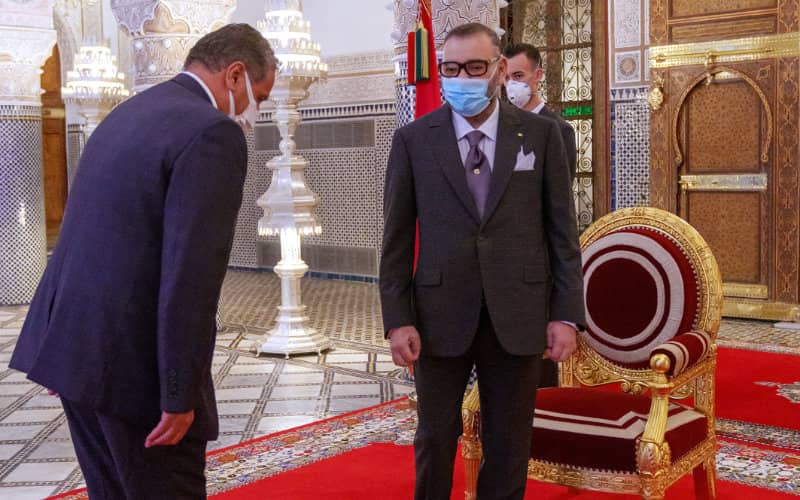
King Mohammed VI received on Friday at the Royal Palace in Marrakech, Aziz Akhannouch, Minister of Agriculture, Maritime Fisheries, Rural Development and Water and Forests, indicates a press release from the Royal Cabinet.
“The King reiterated during this audience his wishes and ambitions for a rural world marked by the creation of new activities generating jobs and income, mainly for young people,” the press release said.
“And this by broadening the scope of agricultural investment to all categories, while promoting the emergence of an agricultural middle class and making agricultural land more accessible to productive investment through the progressive provision, for the benefit of rights holders, of one million additional hectares of collective land, as highlighted during the opening speech to Parliament.”
Mohammed VI thus “reaffirmed the importance of integrating the issues of employment and the reduction of inequalities and the fight against poverty and rural exodus at the heart of the priorities of the agricultural development strategy,” the text continues.
To this end, the Minister of Agriculture was instructed by the King to develop and submit to him “a global and ambitious strategic reflection for the development of the sector,” the press release concludes.
In 2016, a parliamentary report pointed out the limits of the Green Morocco Plan. The report explained that farmers use less fertilizer compared to other countries around the Mediterranean. In France, for example, use is four times higher than that in Morocco. The same goes for the rate of mechanization, which in Morocco is 11 times lower than in Spain. Two important factors which mean that national agriculture, whatever the effort made in terms of incentives, cannot be competitive with its competitors, estimate the authors of the report.
The parliamentary committee also highlighted the low contribution of Moroccan banks to financing agricultural projects: Only 18% of farmers have been able to benefit from a loan since the launch of the PMV. A very low figure which, automatically, impacts the number of operational agro-industrial units. They only represent 24% of the industrial fabric.
source: ledesk.ma