
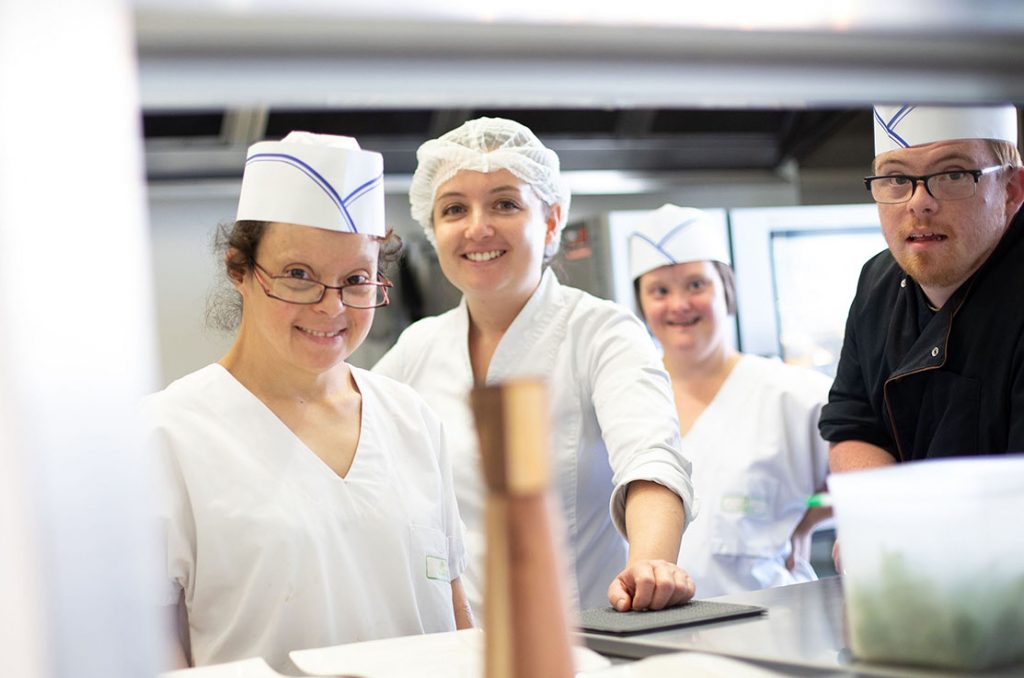
Aspiring to professional autonomy by learning a trade is almost within reach for the young beneficiaries of the HRH Prince Moulay Rachid Center for people with Down syndrome in Rabat. This training and support center, managed by the Moroccan Association for Support and Aid to People with Down Syndrome (AMSAT), now allows these young people to have professional training in cooking and catering. This project thus gives a valuable opportunity to these young people to be able to integrate into society through the profession. “We also ensure that we implement everything that may be necessary for the physical, intellectual and moral development of people with Down syndrome, in accordance with their aspirations,” explains Nahid Ghanem, project manager at the Moroccan Association for Support and Aid to People with Down Syndrome (AMSAT).
To benefit from this training, you must be registered at the center and above all demonstrate an interest in learning this profession, which the young person communicates directly to one of their educators or their parent. Then, an interview is carried out by the specialized educator, the restaurant manager, taking into account the opinion of the psychologist who follows the young person, in order to have an idea of the young person’s motivation and capacity, while respecting the continuity of their life project.
Today, training at the center’s educational restaurant benefits almost 40 young people. Training for cooks takes place from Monday to Thursday, while Friday is dedicated to new and young people who prefer to specialize in the catering workshop (Service, preparation of cakes, jams, tapenades, etc.). Beginners are gradually integrated with older ones with the aim of encouraging them to learn through group exchange. Each team is made up of a maximum of 8 to 10 young people, and benefits, in addition to practical training, from theoretical training with a specialized educator. “Personalized work on a case-by-case basis while remaining in a group helps push them to give more and become better. The atmosphere in the restaurant is one of constant competitiveness and challenge, and the commitment of young people only helps them move forward and surpass themselves,” explains Nahid Ghanem. Preparation for work in the kitchen is done by learning the names of foods, the principles of hygiene, the different units of measurement for capable people, otherwise it is work with pictograms for those who have less capacity. After the initiation, the young cooks move on to applied catering work via the educational restaurant which opens to the public 4 days a week. This choice is made with the aim of placing the young person in a real situation with real customers and a service to provide, while remaining in an environment that they know. The customers initially consisted of the center’s staff, subsequently the restaurant was opened to the public. The dishes are prepared and served by the young people under the supervision of the chefs. Some of the first student cooks have acquired know-how which now allows them to undertake internships in restaurants in the city of Rabat, such as Cosmopolitan, Dhow, Villa Mandarine, the former Le Grand Comptoir. These restaurants welcomed the first interns for experience and now they are always asking for more. One of the beneficiaries of this training even took part in the famous French cooking competition for people with mental disabilities “L’Assiette Gourm’Hand” in 2015. It also happens that the restaurant hosts receptions, such as recently during Ramadan with the “ftour Voyageuses” event where the team had to manage more than fifty guests, while the normal capacity of the restaurant is 40 customers. A major challenge which put the skills of the young cooks to the test and gave satisfaction to everyone.
Training in the educational restaurant of the SAR Prince Moulay Rachid Center remains a great opportunity for professional integration for these young people, at least until work is legalized for people with mental disabilities.
source: leconomiste