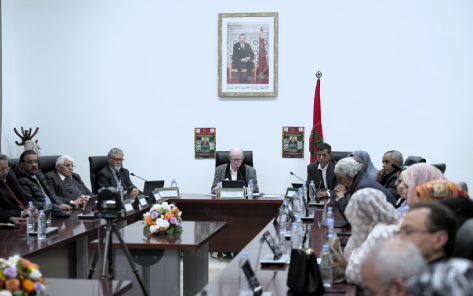

On January 26, 2024, a day of exchange and reflection with Moroccans from around the world was organized by the Ministry of Industry and Commerce and the Council of the Moroccan Community Abroad (CCME), as part of the development of Morocco’s new industrial strategy for 2030. This day of consultation had, among other objectives: to enrich the draft of the new national industrial strategy for 2030 by the contribution of ideas and avenues to explore; to define an exchange framework allowing the continued involvement of Moroccans around the world in the future phases of deployment of the strategy; to suggest a grid of attractiveness indicators (economic and non-economic) of skills and talents in the field of industry in Morocco compared to other countries. A context marked by the skills of Moroccans around the world In his opening speech, the President of the CCME, Mr. Driss El Yazami, spoke of the changes in the Moroccan population abroad, with the evolution of its academic level on the one hand (1/5th holds a bac + 6) and its feminization on the other hand. He retraced the skills mobilization policies including, among other things, the evaluation of new programs. With questions for the future: how to ensure the sustainability of programs and how to involve local authorities in this process? As host of the day, the Minister of Industry and Commerce, Mr. Ryad Mezzour, recalled that Moroccans around the world constitute a vector of wealth. And to emphasize the speeches of His Majesty King Mohammed VI on August 20, 2022 (on the occasion of the 69th anniversary of the Revolution of the King and the People) and March 29, 2023 (message to participants in the 1st edition of the National Industry Day). And this, in the context of transformations in the Kingdom since the Monarch’s accession to the Throne in 1999, with, among other things, the 55 free trade agreements signed with 150 countries for a market of 2.5 billion euros, and multiple investments in infrastructure. All in the light of the sectoral strategy with the National Pact for Industrial Emergence of 2009, the Emergence Plan of 2015, the Industrial Acceleration Plan 2014-2020, the corollary of which was the evolution of the business climate through the development of industrial zones and the increase in skills through investments. Read also: The development of four industrial zones in the Casablanca-Settat region In hybrid mode (face-to-face and video) at the headquarters of the Ministry of Industry and Commerce, this day brought together eminent people from four continents (Africa, America, Asia and Europe) (innovation strategists, entrepreneurs, lawyers, elected officials, students, engineers, investors, project managers, etc.), in all sectors of industry – aerospace, automobile, aviation, electrochemistry, high technology, pharmacy, physics, robotics, innovative start-ups… The participants expressed themselves within the framework of two reflection panels each articulated by a moderator: – Moroccans of the world and the industrial development of Morocco: what possible contribution within the framework of the new strategy? – For an effective contribution to the objectives of the new national industrial strategy: what levers of action for Moroccans around the world? A force of proposal at the service of an emerging Morocco The observation that Moroccans around the world actively participate in innovation, research and production in the industrial sector of their country of residence was unanimous. It was obvious that they, along with others, have long been a lever for development and growth in host countries. As already highlighted in the April 2021 General Report on the New Development Model opment (page 158), “the specificity of MDMs as connectors from Morocco to the rest of the world constitutes a great opportunity to be seized. Through their role as a “bridge” between the national market and international markets, MDMs will be able to help raise capital, develop new partnerships or access skills or expertise absent in Morocco, or even promote Moroccan products and services. » That they are a real vector of expertise, solidarity, human resources and investments for Morocco, able to actively contribute to its industrial development, is common sense. Subjectively, integration into the societies of residence, identity attachment to Morocco as well as the strengthening of links with the Kingdom, and citizenship in the host countries were shared issues. Pragmatically, the need to analyze the networks of Moroccan experts around the world and their interaction with Morocco, the necessary skills in the industrial fields targeted within the framework of government projects and their implementation in Morocco was put forward. Objectively, the need for the establishment of institutions specialized in the mobilization and transfer of knowledge and skills, the extension of databases on expatriate skills, and structures to support the real integration of Moroccans around the world in the process of industrial development in Morocco was noted. Living in a biculture which can create a new managerial relationship and decision-making efficiency, lobbies with administrations which can provide relays, capable of ensuring Research and Development and supporting a management function with the heads of SMEs in Morocco, Moroccans around the world have innumerable assets that must be curbed by a public policy structured with considerations that are as concrete as they are pragmatic. This was the intended meaning of this dense day called consultation, which was to seek consensus with a view to the execution of a common project, namely the industrial strategy under High Royal Instruction. Let us bet that this dynamic materializes in the collective Moroccan interest in this period of profound changes and turbulence, both regional and international, so that the Kingdom occupies a growing role between the four main continents, considering Morocco’s display of a stronger and more solid position. A requirement commensurate with the challenges and influence of Morocco In his speech addressed to the Nation on the occasion of the 48th anniversary of the Green March, His Majesty King Mohammed VI hoped that “the Atlantic coast becomes a high place of human communion, a pole of economic integration, a center of continental and international influence. » It is within this framework that the strategic project of the Morocco-Nigeria gas pipeline is evolving. And it is in this concrete dynamic that the Monarch launched the Atlantic initiative in order to give the Sahel States access to the Ocean by making road, port and rail infrastructure available to the four countries in the region. The stakes are immense – consolidation of security, stability and shared prosperity of the African Atlantic strip and international influence of the Southern Provinces. In this context, the Moroccans of the world constitute an inexhaustible resource which must be understood outside the reductive prism of investment. We also hope that consultation days will increase with the active participation of the CCME in areas as fundamental as research and development, agriculture and fishing, tourism and crafts, energy, mines and the environment, culture and youth. The major deadlines of 2025, the Sustainable Development Goals (SDGs) as well as the 2035 outlook for the New M model of Development relating to youth, digital and the green economy at the national level, as well as the 2030 horizon with nothing less than the co-organization of the football World Cup, pose a requirement: a call to this potential as rich as it is plural that are the Moroccans of the world, which must be understood with a clear vision and an applied method of consultation and integration.
source: maroc-diplomatique.net