
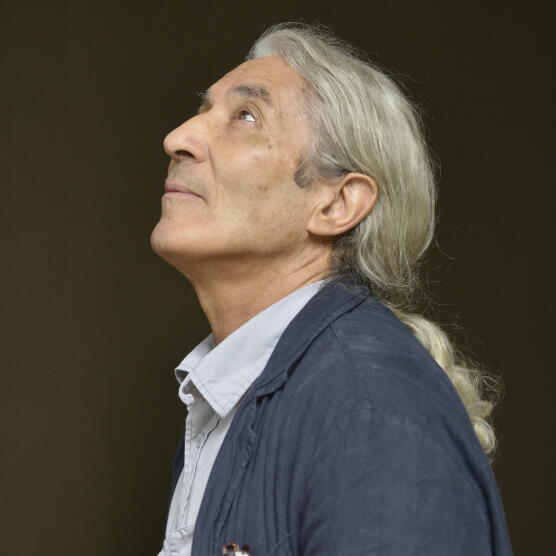
Boualem Sansal: “The future belongs to science, there is nothing more to expect from religions”

You can share an article by clicking on the share icons at the top right of it. The total or partial reproduction of an article, without the prior written authorization of Le Monde, is strictly prohibited. For more information, consult our general conditions of sale. For any authorization request, contact syndication@lemonde.fr. As a subscriber, you can gift up to five items per month to one of your loved ones using the “Gift an Item” feature. https://www.lemonde.fr/livres/article/2024/01/12/boualem-sansal-l-avenir-appartient-a-la-science-il-n-y-a-plus-rien-a-attend-des-religions_6210414_3260.html In the new novel by Algerian writer Boualem Sansal, born in 1949, Vivre. Countdown, Earth is doomed to disappear into a black hole. Religions, contrary to science, appear powerless to grasp the reality of the catastrophe and the possible escape routes. The novelist explains the links between this desperate and ironic dystopia and certain current phenomena. Are the promises of science, of quantum physics in particular, capable of consoling the misfortunes of the present? Yes, the future belongs to science, and we can clearly see that there is nothing more to expect from religions, the Bible, the Koran or the Vedas. Furthermore, we cannot deprive man of the desire to find “the” solution that would protect him from suffering and death. Some have placed their trust in Olympus, gods, and in the one God. But this is no longer worth anything in the face of the perspectives opened up by quantum computers and artificial intelligence, which infinitely multiply human capacities to design the universe. Thus the idea of a linear time where past, present, future follow one another turns out to be false. In reality, past, present and future are intertwined. This is what I wanted to portray in my novel. The heroes must choose the “chosen ones” who will be admitted to the interstellar rescue ship. Doesn’t their difficulty in agreeing on a criterion illustrate, a contrario, the compassion that we must feel towards those who do not resemble us, that which we find in various places in your work, in particular in « The Village of the German » (Gallimard, 2008)? Compassion actually takes us out of our head-to-head with ourselves. At the beginning, Jason and Paolo, the protagonists, are isolated. They have the choice to keep the truth as their instrument
source: lemonde.fr