
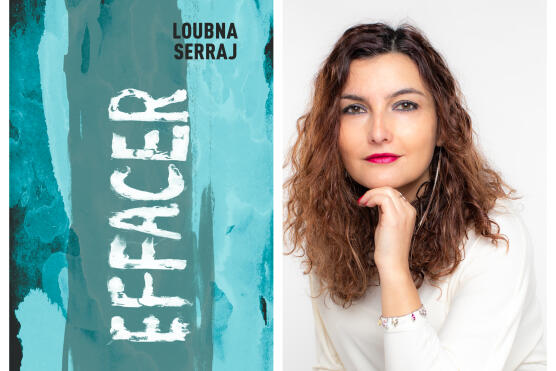
THE BOOK OF THE WEEK. With her second novel, the Moroccan author, winner of the 2021 Orange Book Prize in Africa, once again addresses the question of the couple while daring to evoke the taboo of homosexuality in the kingdom.
We have the impression of starting a sentimental novel when reading the first lines of Erase, the second novel by the Moroccan author Loubna Serraj. A narrator, Lamiss, writes letters full of lyricism to her great love. But behind the somewhat outdated nature of such correspondence, a first, more dramatic clue emerges: although numerous and regular, the missives are sent towards nothingness. True love is out of reach, the relationship having been brutally interrupted. By what? For what ? Will she ever be able to resume? Reading will allow you to understand and gradually reconstruct the whole story.
You can share an article by clicking on the share icons at the top right of it. The total or partial reproduction of an article, without the prior written authorization of Le Monde, is strictly prohibited. For more information, consult our general conditions of sale. For any authorization request, contact syndication@lemonde.fr. As a subscriber, you can gift up to five items per month to one of your loved ones using the “Gift an Item” feature. https://www.lemonde.fr/afrique/article/2024/01/21/effacer-de-loubna-serraj-au-c-ur-de-l-amour-entre-deux-femmes-au-maroc_6212086_3212.html The portrait of Lamiss is expanding. A young city dweller, a French teacher in a high school, she likes to stimulate the critical thinking of her students through the discovery of literary works and the viewing of series or films. For the rest, Lamiss makes very few connections and hides his inner wounds behind an affable appearance. Everything is going very well, she claims, while also trying to persuade herself. And when the wife of his only friend, a work colleague, worries about his extreme pallor, Lamiss diverts the conversation: “I’m sure you’re exaggerating, Doha. I must have forgotten to put my foundation on the last few days. » The plot builds little by little, between correspondence, narrative passages and dialogue sequences, the author using her same deliberately light style throughout the pages. A form that allows him to approach, without seeming to touch it, the subject of tension at the heart of his book: the love between two women. Because Lamiss’s passion is named Nidhalé, a photographer reporter whom she still loves desperately despite their breakup, and whose destiny the second part of the book will retrace.
The courage to live freely Aerial writing and a profound subject, such is the contrast which gives its particular flavor to this novel. A way of addressing, in a gentle way, the taboo represented by female homosexuality in Morocco. Without crudely taking sides with her protagonists, Loubna Serraj strives to show the unpredictability and sincerity of their love: “From the moment our eyes met, my world was turned upside down. No, it started to exist. (…) You were a woman, I was one too. »
On the other hand, it depicts the Moroccan bourgeoisie – the environment from which Nidhalé comes – radical and violent on this point, which rejects the very idea of natural orientation or sincerity of feelings and limits itself to judging relationships between people of the same sex through the prisms of decorum, religion and illness. Thus, Nidhalé’s parents will seize the opportunity of an accident which leaves their daughter with amnesia to try to reinvent her past.
source: lemonde.fr