
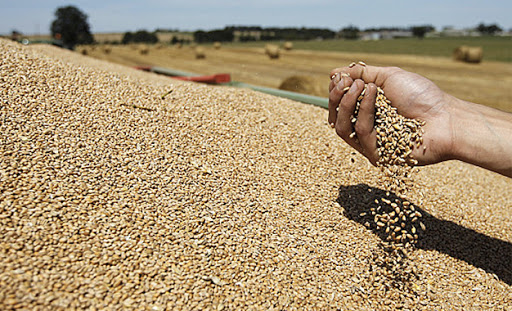
Look at these beautiful ears of wheat,” proudly exclaims Ethiopian scientist Wuletaw Tadesse Degu, inspecting a field, near Rabat, sown with drought-tolerant seeds, which have become “essential” for a country threatened by climate change like Morocco. The small rural town of Marchouch, 70 kilometers southeast of the capital, has housed since 2013, on an area of 120 hectares, a major experimental station for International Center for Agricultural Research in Arid Zones (Icarda) which develops varieties, particularly cereals, resilient to climatic hazards. Its green fields of wheat and barley with dense ears contrast with the critical situation in the country where the agricultural season is compromised by a sixth consecutive year of drought.
Drought-tolerant cereal seeds, an alternative for the future in Morocco MAY 3. 2024 At 7:01 p.m. (UT) Updated May 3, 2024 at 7:01 p.m. (UT) By AFP By Kaouthar OUDRHIRI © 2024 AFP Image A researcher from the International Center for Agricultural Research in the Arid Zones (Icarda) in a cultivated field in the Marchouch region, in north-west Morocco, on April 18, 2024 A researcher from the International Center for Agricultural Research in the Arid Zones arid (Icarda) in a cultivated field in the Marchouch region, in north-west Morocco, on April 18, 2024 AFP FADEL SENNA Share4 minutes of reading « Look at these beautiful ears of wheat », proudly exclaims Ethiopian scientist Wuletaw Tadesse Degu, inspecting a field, near Rabat, sown with drought-tolerant seeds, which have become « essential » for a country threatened by climate change like Morocco, the small rural town of Marchouch, 70 kilometers southeast of the capital, has housed since 2013, on an area of 120 hectares, a major experimental station of the International Center for Agricultural Research in Arid Zones (Icarda) which develops varieties, particularly cereals, resilient to climatic hazards. Its fields of wheat and barley, green and with dense ears, contrast with the critical situation of the country where the season. agricultural production is compromised by a sixth consecutive year of drought. Video file Low rainfall has reduced the area sown with cereals from 3.7 million in 2023 to 2.5 million hectares planned for 2024, according to the Moroccan Central Bank This year, cereal production should be halved to 25 million quintals compared to 55.1 million in 2023, pushing the country towards more imports, according to the same source. “The difference in quality between our land and that of other farmers is striking. It becomes essential to adopt resilient seeds and deploy them quickly,” explains to AFP Mr. Tadesse, head of the soft wheat improvement program at Icarda, which has six laboratories and a gene bank in Rabat. Potential According to the Ethiopian expert, the potential of these varieties also lies in improving yield: in 2023, cereal productivity was on average one to two tonnes per hectare in Morocco.
In Marchouch, it was four tonnes per hectare with only 200 millimeters of rain – half of what the region normally receives -, thanks to drought-resistant varieties but also to optimal agricultural management: choice of the right time for sowing, adapted quantities and exceptional use of irrigation (10 mm of water on part of the 120 hectares). Barley production increased from 1.5 tonnes to two tonnes per hectare. hectare with resilient varieties in severe climatic conditions, underlines Miguel Sanchez Garcia, barley improvement specialist at Icarda. An enormous potential which arouses interest around the world, more than 300 promising lines, developed mainly in Morocco thanks to the crossing and transfer of genes from wild wheat seeds and wheat ancestors, are sent each year to 90 national varietal creation programs around the world, indicates Ahmed Amri. researcher in genetic resources at Icarda.