
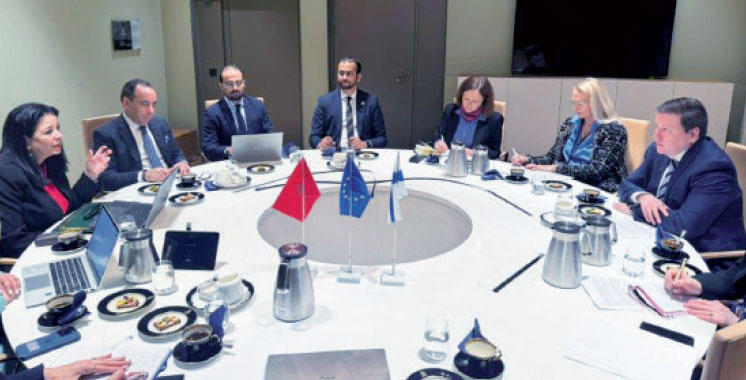
Technology. The Moroccan telecommunications market attracts the main countries supplying cutting-edge technologies such as 5G and artificial intelligence. This is the case for Finland which could strengthen itself in the Kingdom. Lighting. The race to deploy 5G in Morocco is on. Morocco therefore attracts world leaders in the field, notably the Chinese but also the Nordics. This is particularly the case for Finland, country of origin of the famous Nokia brand. Although the Finnish giant has voluntarily reduced its scope in the field of smartphones, it remains one of the main suppliers of cutting-edge technologies throughout the world, particularly with regard to fixed and mobile networks. The upcoming launch of 5G in Morocco is therefore arousing desire and competition will certainly be tough. In the meantime, competitors are positioning themselves in this market with high growth potential. Finland could be among the favorites. In any case, those responsible in this Nordic country seem ready to strengthen the partnership with the Moroccan side, particularly in the field of AI (artificial intelligence) and of course 5G. In this sense, the Minister Delegate in charge of digital transition and administrative reform, Amal El Fallah Seghrouchni, visited the headquarters of the Nokia Group in Espoo, Finland, on Tuesday January 28, 2025. She was accompanied by Mohamed Achgalou, Moroccan ambassador to Finland and Estonia, as well as Marjana Saal, Finnish ambassador to Morocco. During this visit, the minister had the opportunity to discover Nokia Executive Experience Center, where she attended immersive demonstrations of the solutions developed by the group. She underlined Morocco’s pride in welcoming Nokia’s first innovation center in Africa and the Middle East to Salé. She highlighted the Kingdom’s strengths, including a favorable investment climate and the skills of young people specializing in advanced technologies, thus calling on Nokia to strengthen its presence in the country. Previously, the minister held a working meeting, still in Helsinki, with the Finnish Minister of Transport and Communications, Lulu Ranne. The discussions focused on ways to strengthen cooperation between the two countries in the areas of research, technological innovation, digital infrastructure and data. On this occasion, Lulu Ranne presented the broad outlines of the Finnish national strategy on artificial intelligence, put in place in 2017 to support research and teaching in this area. An initiative that ranks among the first globally. For her part, Amal El Fallah Seghrouchni stressed the importance of leveraging Finnish experience in artificial intelligence and advanced technologies, while insisting on the need to share best practices to strengthen Moroccan expertise in these areas. During the same trip, the Moroccan minister met Ville Tavio, Finnish Minister of Foreign Trade and Development. The discussions focused on the need to strengthen partnership and cooperation in areas linked to digital transition, artificial intelligence and advanced technologies. On this occasion, the minister presented an overview of the various digital projects underway in Morocco. She also highlighted the multiple opportunities that Morocco offers as a leading destination in Africa, highlighting the skills of young Moroccan talents in advanced technologies. Broadband Morocco, which is preparing for important deadlines at the international level, wants to accelerate the e deployment of 5G and optical fiber. In her presentation on “Digital development in Morocco”, during a meeting of the Committee on Public Finance Control and Governance last Tuesday, Ms. Seghrouchni mentioned a deployment schedule. In detail, the minister stressed that 5G coverage will be extended to cover 25% of the population by 2026 and 70% by 2030, with intensive coverage of the cities which will host the 2030 World Cup. Thus, she recalled that 1,800 areas will be covered with a minimum speed of 2Mbps, as part of the implementation of the second phase of the National Broadband Plan (PNHD2), in addition fiber optic coverage through the equipment of 5.6 million homes by this network by 2030, and the equipment of 6,300 public administrative sites with an optical fiber internet service by 2026. Regarding cloud services, the minister mentioned the “Cloud First Policy” project intended to encourage administrations to adopt “the cloud” and to “support and accompany digital administration in exploiting the potential of cloud technologies for development of the digitalization of public services and improvement of their quality”, in addition to continuing efforts to attract technology giants and establish basic infrastructure that complies with international standards and meets local requirements. Concerning the digital maturity of public administrations, Ms. Seghrouchni indicated that a technical study was carried out to determine the level of maturity of administrative data registers. And to add that the Ministry of Digital Transition and Administration Reform is working to develop a reference framework to define the methodology for evaluating and measuring the digital maturity of administrations and identifying its indicators and measurement mechanisms. Regarding AI, Amal El Fallah Seghrouchni indicated that the ministry is looking into establishing a roadmap to apply priority use cases of artificial intelligence (AI) within Moroccan administrations, as part of its support for the digitalization of public services (see box). AI: Strategy According to the Minister Delegate in charge of digital transition and administration reform, Amal El Fallah Seghrouchni, the ministry has identified and defined the priorities of AI use cases with the aim of improving public services and satisfying users, noting that important initiatives have been launched for the activation of artificial intelligence in the Kingdom. Ms. Seghrouchni stressed that the efforts made focus on the development of the digital economy through “supporting and strengthening the AI ecosystem, supporting startups in this area, particularly those operating in sectors with high added value, supporting research and development efforts and encouraging innovation in AI. Other measures consist of “attracting international companies specializing in AI and encouraging existing companies to develop high value-added service offerings,” she added. Regarding the digitalization of public services, Ms. Seghrouchni revealed that the ministry will launch, on February 14, the unified electronic portal of public services, specifying that this platform is designed to aggregate, classify and facilitate access for public administration users to the various public services available online.