
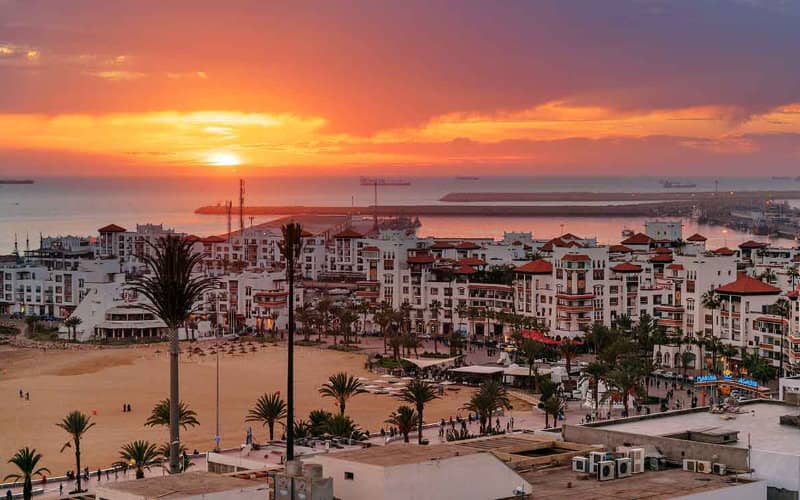
In a context where Agadir must face competition from destinations such as the Canary Islands, Turkey or even Egypt, the “sun and sea” label has long no longer been a sufficient factor of attractiveness.
The good news is a growth in tourist activity in Agadir in recent months. According to figures communicated by the Souss-Massa Regional Tourism Council, the seaside resort recorded a double-digit increase in its overnight stays of 10.63%, at the end of the 12 months of 2017. During this period, the number of overnight stays reached 4.67 million compared to 4.22 million overnight stays recorded in 2016. For its part, the average occupancy rate of classified hotel establishments also increased by 9.29% to reach 51.75% against 47.35% in 2016.
This increase in activity, however, remains entirely relative. Although today it has 29,115 beds, or nearly 5,000 additional beds in ten years, the Agadir destination is still barely doing what was achieved in 2007. At the time, in fact, the seaside resort reached 4.47 million overnight stays and an occupancy rate of 56.46%. Also despite the upward trend, tourism professionals remain concerned. This is especially true since the new direct air links recently established have not yet really boosted activity. At least that’s what tourism stakeholders in Agadir say, with supporting figures. For them, it is important to review this new air programming to better match the real needs in terms of air access to the seaside resort.
The current improvement in tourist activity has, moreover, no real impact on the economic activity of the city or even on all the tourism sectors in the region. Throughout the seaside resort, this situation is evident. The restaurants and cafes on the seafront are almost empty during the day and evening, as are the bazaars in the city center, presenting a picture of desolation which deceives no one about the scope of this increase in tourist activity. It is also an indicator of the extent of the crisis that a large number of tourism activity segments in the city have been experiencing for years.
Certain traders, such as bazaar or restaurant managers, will often argue that what has harmed their business is the all-inclusive product offered by a large number of seafront hotel establishments. We forget, however, that the development of all-inclusive in the destination corresponds to customer demand and a global trend that it was difficult to ignore at the risk of losing market share. The time when the city’s cafes, restaurants and businesses could simply open their doors and wait for customers seems to be long gone. These activities today require an aggressive commercial approach on all fronts, inevitably through a plural marketing approach, a welcome in which actions and attention are combined, as well as a quality product. Elements that it is important to take care of because the informed tourist today never fails to find out about his destination on the Web and on site obtain information at the receptions of hotel establishments as well as from taxi drivers about places to visit and where to eat. He knows very well that it is more interesting to do his shopping in the city than in hotel souvenir shops.
It should also be emphasized that what really competes with the shops on the seafront or those in the city center is the large souk which, behind its large ramparts, constitutes a real heart of life in the seaside resort and an economic lung of the region which attracts large numbers of residents and tourists from the city every day.
How can we get Agadir out of its lethargy and see real benefits from tourist activity in the region? The question certainly raises that of the Agadir product, better known internationally for its seaside profile. In a context where Agadir faces competition from destinations such as the Canary Islands, Turkey and Egypt, the “sun and sea” label has long no longer been a sufficient factor of attractiveness. The successful experience of niche surfing, which for years has attracted hundreds, even thousands of surfers each year to the locality of Taghazout, clearly shows that it is important to diversify the product and focus on niche tourism to position yourself in relation to the competition and create a distinct brand identity.
By welcoming athletes in recent months for their high-level sports training, it is of course this approach to developing niche tourism that the seaside resort tourism players are moving towards. Agadir has no shortage of assets at this level to attract sports tourism. In the opinion of experts in the field, it is enough to strengthen investments in this promising sector in terms of training equipment, suitable accommodation and qualified human resources.
Building a new solid tourism label also requires improving the urban environment. “The strengthening of signage and lighting, as well as the beautification of the existing and its enhancement, still need to be done,” underlines an observer. Visitors to the city and its residents alike often point out the city’s dim lighting in the evening. Which really does not encourage tourists to go out and gives a sad image of the seaside resort after dark. In addition, the city center, which constitutes a model of urban planning designed by great master architects and defenders of the modernist movement, is today poorly preserved and not sufficiently highlighted. The circuit of buildings from the first stage of the reconstruction of Agadir could constitute a tourist asset to exploit. Telling the story of the reconstruction of the city after the 1960 earthquake and the challenge faced by this operation could be interesting and would allow a special label to be given to the destination.
The region also offers other potential such as its hinterland and its terroir. These elements come in a thousand ways with originalities specific to the locality and constitute an authentic character which must be taken advantage of again and again to make the destination more attractive. This competitive advantage, however, suffers from insufficient promotion.
In this context, we note the importance for each tourist business in the region to further develop its presence on the Web to combine with the institutional communication implemented in favor of the destination.
Faced with the multiple challenges facing Agadir today, strengthening the synergy of all the city’s stakeholders and a creative approach are essential to building a new brand image, specific and attractive territorial branding. The tourism activity also calls upon a plurality of stakeholders who must be made aware and mobilized beforehand. There is also infrastructure and equipment, such as cleanliness, urban transport, taxis, in which it is essential to invest again and again. Agadir and its region deserve all of this!