
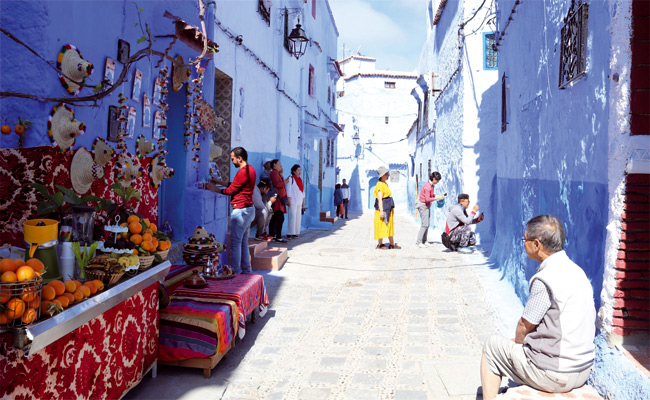
Tourism Chinese market Tourists stranded at home due to lack of visas from the Moroccan embassy.

Chinese consumers spent more than 1 trillion yuan ($163 billion) overseas in 2014. The number of Chinese outbound travelers exceeded 100 million, and their total spending amounted to more than 1 trillion yuan, according to data from China’s Ministry of Commerce.

Chinese consumers spent more than 1 trillion yuan ($163 billion) overseas in 2014. The number of Chinese outbound travelers exceeded 100 million, and the total amount of their spending was more than 1 trillion yuan, according to data from China’s Ministry of Commerce.
Already in 2012, China spent USD 102 billion on outbound travel, a figure that made it the world’s leading tourism source market in terms of spending. For the past decade, China has been the fastest growing tourism source market in the world. She still is. Rampant urbanization, rising disposable incomes and the easing of restrictions on foreign travel explain the skyrocketing number of international trips by Chinese people, which rose from 10 million in 2000 to 83 million in 2012.
Spending by Chinese tourists abroad has also increased almost eightfold since 2000. Encouraged by the appreciation of their currency, the Chinese spent a record figure of 102 billion USD on international tourism in 2012, or 40% more than the 73 billion in 2011.
These figures speak for themselves and no need for extensive commentary. In this context of progressive development of the Chinese market, all tourist countries are doing as much promotion and contact as possible to attract Chinese tourists to their country. Morocco, as a tourist-oriented country and within the framework of the 2020 vision, should do its best to position itself on the Chinese market.
Unfortunately, very reliable information comes from Moroccan tourist operators working with the Chinese market who are scandalized to experience an anachronistic situation against the tourism promotion of Morocco. During the month of September and to the present day, the Moroccan embassy in Beijing no longer issues visas.
Alerted by their Chinese colleagues, tour operators are making contacts to see what is happening. Explanation given officially from Beijing: the ambassador is on leave and the lady official in charge of visas has gone on maternity leave. Understand, no one issues visas anymore and the wait only lasts for the Chinese who want to come to Morocco.
Travel professionals had done what was necessary by booking hotels, excursions, coaches and Chinese-speaking guides. But nothing is moving forward and the entire tourism chain is destabilized. Tour operators have therefore lost groups of Chinese customers due to lack of visas. Group of 26 people for this one. 10 high-ranking Chinese personalities for the other. 2 groups of 40 people etc… certain participants in the WTCF (World Federation of Tourist Cities) which should take place in October in Rabat and Fez, no longer obtain visas. So a tour operator stupidly lost 70 customers and 40 are expected to date. A real scandal. “It takes away the desire to work in the tourism sector,” exclaims one operator. However, the alternative solution exists. This is the possibility of issuing visas on arrival at the airport, for a limited period, for tourists who come as part of an organized trip, as long as all the information is recorded with the Moroccan operator. Alas, there is still no way out…
So what can I say? Quite simply: we are a long way from the economic diplomacy advocated by HM King Mohammed VI. However, tourism is a vital component in the national economy. We would like to see our ambassadors involved in the development of tourism, like Chrifa Lalla Joumala in London. Unfortunately this is not the case for many to enter them.
In Agadir we recently experienced the refoulement of a 14-year-old German boy who accompanied his parents for a two-week stay in Agadir, because he did not have his passport with him. No one can dispute the fact that security services at airports and ports at border crossings do their job according to the rules. But all the same, there are the texts and the spirit of the texts.
Tourism is a whole. It begins with the granting of a visa, reception at border crossings, tourist information, quality services, etc. The Chinese market with its 100 million tourists is a huge market. This is double what the two major European tourist countries, France and Spain, receive in terms of foreign tourists.
If Morocco manages to attract just a few thousand Chinese tourists, this would serve its tourism promotion in order to truly develop the Chinese market for Morocco. These are the negative actions of certain officials (case of the Beijing embassy) which are seriously detrimental to the development of tourism. It is high time that this stops and that good coordination is established on solid and definitive bases between the Department of Tourism, that of Foreign Affairs and that of the Interior.
thr magazine