
One week before COP22, the commissioner in charge of the event invited the media partners of the event to discover, in preview, the interior of the Bab Ighli village, which will welcome up to 20,000 delegates for eleven days. Médias 24 made the trip.
Marrakesh. At the intersection of Avenue Mehdi Ben Barka and Route de l’Ourika, is one of the main entrances to the village of Bab Ighli, where the event of the year will be held, the 22nd edition of the Conference of the Parties on climate, COP22.
The entry in question is reserved for delegates, ministers and the media. The entrance gate of the heads of state, for its part, is on the other side of the village.
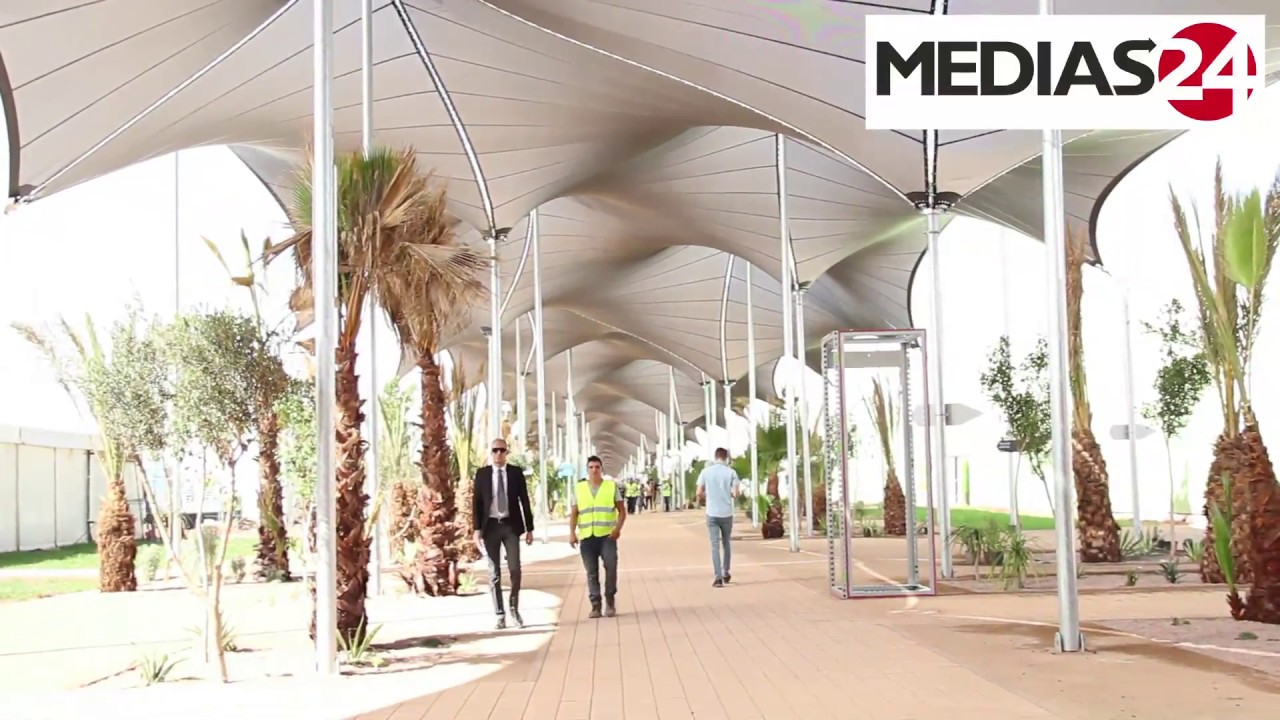
Passing the security checks, we find ourselves in a long alley topped by a canopy 700 meters long and 26 meters wide, whose particular design was inspired, according to the site managers, by tents Moroccan Berbers. Each side of the avenue runs along the different neighborhoods of the village.
As previously announced, the village has a blue zone under UN flag, reserved for UN negotiations and heads of state; as well as a green area , under the Moroccan flag and where innovations from private companies will be presented, as well as exhibitions from civil society. 180 NGOs will follow one another on the 120 stands in the area, offered free of charge.
In the same place bringing together the exhibitions, one of the 4 business centers in the village, equipped with computers for the benefit of participants and visitors who do not have computer equipment. The green zone also has 5 large structures, which will accommodate delegations from 52 countries that have already reserved space for their offices or pavilions.
Next, there is the space called « Agora ». It brings together two restaurants built entirely of wood. Able to accommodate up to 1,200 people, the Agora will absorb the village’s catering activity, thus offering visitors a varied cuisine, including Moroccan cuisine. Cafeterias and coffee points are scattered throughout the site, in order to dilute the flow during peak hours.
In addition, the site has two plenary rooms: one of the two has a capacity of 1,300 people, while the other can accommodate up to 1,600 people: « Its capacity will even increase, since we We are going to add chairs in the front row so that the Heads of State can be in front of the speakers », explains Maxime Rosenwald, project director at GL Events, the company responsible for the village works.
At the entrance to the large plenary room, a large monumental door. The pride of the organizers, it is entirely built using wooden blocks only, and required a month of work by an entirely Moroccan team. It was designed by the architectural firm Oualalou+Choi.
Then, the negotiation district: composed of 30 rooms articulated around 4 corridors, each corridor will house an exhibition, i.e. 4 exhibitions in total, including one by Yann Arthus-Bertrand and another by Royal Air Maroc.
At the end of the avenue, a room reserved for the media, equipped with 900 seats. Three other rooms are reserved for press conferences. 1,500 journalists have been accredited to cover COP22.
And to face the heat of the Marrakech climate, all the structures in the village are, of course, equipped with air conditioning ducts. A WiFi connection is available on the site. It is provided by the UN, in collaboration with telephone operators: “The three operators [Maroc Telecom, Méditel, Inwi, editor’s note.] have strengthened their GSM, 3G and 4G networks around the site,” continues Mr. Rosenwald.
Basically, 27 hectares of the Bab Ighli site have been developed. The covered structures, equipped and fitted out, cover 120,000 m²: “We still have some work related to decoration, landscaping and a little more signage, but everything will be delivered on time,” adds Mr. Rosenwald. The organizers announced last week that 98% of the site had been delivered.
However, the project team does not deny having encountered some difficulties in the construction of the site, particularly in terms of earthworks: « The earthworks were more complicated than expected », indicates our guide. « We are in an area where there were khettaras , which are traditional wells dug into the ground to collect water from the Atlas Mountains. We had to ensure that all the structures were stable and that we had not built on soft ground. »
Remember, the cost of the village amounts to 430 MDH, and it mobilized nearly 180 Moroccan companies.
Source: https://www.medias24.com/MAROC/Environnement/168176-COP22-a-Marrakech-Visite-guidee-du-site-de-Bab-Ighli.html#