
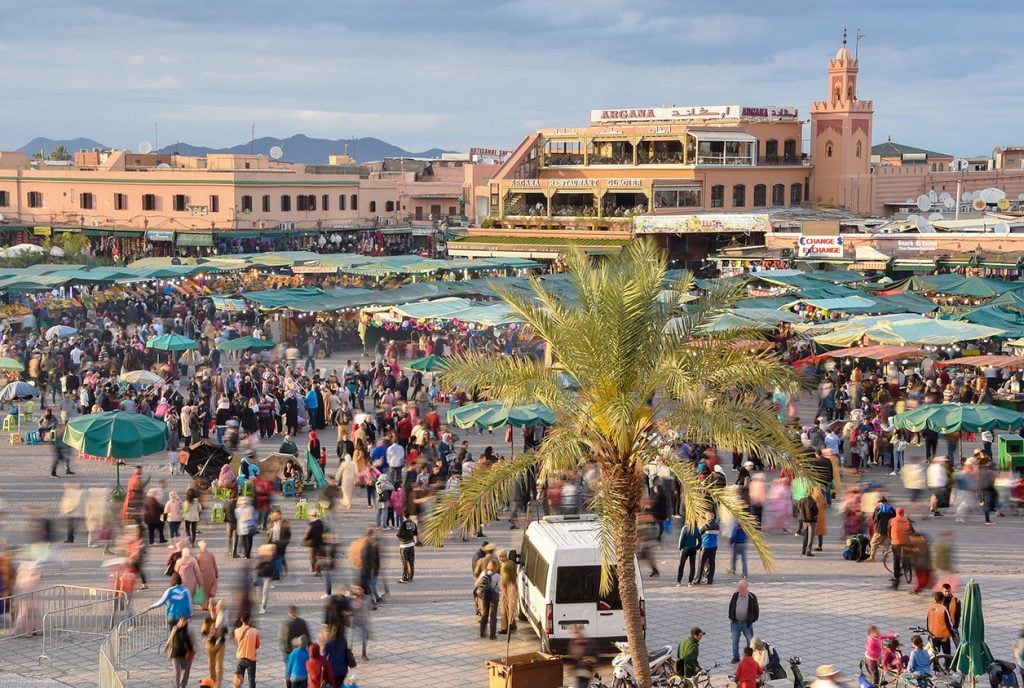
Particularly affected during the pandemic linked to covid19, the tourism sector continues its improvement that began last January. The activity benefits from the resumption of global tourism, but also from the multiple measures put in place by players in the sector, in particular the Moroccan National Tourism Office (ONMT) which has led a major offensive on source markets, notably through its international campaign “Morocco land of light”, which has been a great success. The sector also benefited from the formidable performance of the Atlas Lions during the World Cup in Qatar, who propelled the Kingdom onto the radars of international tour operators. Thus, the dynamic that has characterized tourism since the start of the year was consolidated in June 2023, when the volume of arrivals at border posts reached nearly 1.4 million tourists, or +25% compared to 2019, according to figures from the Ministry of Tourism. And for the first six months of the year, the number of arrivals stood at 6.5 million tourists, an increase of 21% compared to 2019. Several markets contributed to this performance, notably Spain (+79% Vs. 2019), the United Kingdom (+23% Vs. 2019), Portugal (+16% Vs. 2019) and the Israeli market (+96% Vs. 2019), specifies the guardianship. At the same time, in terms of productivity, the sector generated 41 billion DH in travel revenue in foreign currency at the end of May 2023, an exceptional increase of 42% compared to the same period of 2019. Optimism The ministry is resolutely optimistic, estimating that “these achievements combined with offensive promotional actions augur an exceptional summer season”. Let us recall, in this regard, that numerous partnerships have been signed with tour operators and online travel agencies in order to secure 2.8 million customers for the 2023 summer season, i.e. double the volume secured for summer 2019. “Sector indicators demonstrate the very good health of our tourism. Our ambitions are obviously greater within the framework of the roadmap and we will continue to work with the entire industry and deploy the necessary means to achieve our quantitative and qualitative objectives,” underlines the responsible minister, Fatim-Zahra Ammor. The objectives set in the roadmap could even be exceeded by the end of 2023. Indeed, according to economist and tourism expert Zoubir Bouhoute, “with 6.5 million tourists in the first half of the year, we are on the right track, knowing that a good part of the increase comes from Moroccans around the world (MDM, editor’s note). We are therefore tending towards a balance between foreign tourists staying and MDMs. As a result, I think we will easily exceed 13.5 million arrivals by the end of the year. I remain more optimistic than the tourism roadmap which expects 12.9 – 13 million arrivals in 2023.” You should know that Morocco has initiated a huge number of promotional actions, which have been supported by the multiplication of air connections with traditional markets and emerging markets. Nevertheless, admits Bouhoute, “there remains a lot to do in certain countries where our performances are not good, including in particular the German, Dutch and Belgian markets, where we recorded respective declines of 34, 37 and 24% at the end of May 2023. And for the French market, the progression was limited to 2%”. According to our interlocutor, we will have to act by increasing air and maritime connections to better position ourselves in these markets, and especially in Germany which remains the first emitter in Europe, and will be the second in the world after China in 2030. “At that date, China will have 250 million international tourists compared to 151 million German tourists,” he says. Some challenges to overcome to consolidate the dynamic The sector’s roadmap aims, by 2026, to attract 17.5 million tourists, to reach 120 billion in foreign exchange earnings, to create 80,000 direct and 120,000 indirect jobs, in addition to repositioning tourism as a key sector in the national economy. Achieving these objectives will therefore require consolidating the dynamics currently observed. This will involve the lifting of certain constraints linked, among other things, to governance problems, the mismatch between supply and demand, deficits in terms of air connections, as well as the weakness of the national tourism offer. Added to this is the high concentration of reception destinations (Marrakech, Agadir). It therefore seems important to promote other Moroccan cities in order not to consolidate the bipolarity of Marrakech-Agadir. “We must try to ensure equitable distribution among all destinations in Morocco in order to share the tourism benefits with all regions,” suggests Bouhoute. On another note, there is the need to further promote domestic tourism, a segment where the problems become particularly salient during the summer period. “In summer, there is indeed strong demand from international tourists. Then there is Operation Marhaba where, of the 3 million planned entries, approximately 2 to 2.4 million are concentrated in the July-August period, which coincides with the school holidays of resident Moroccans. There are thus 3 factors which contribute to increasing demand, while on the other hand the supply is not keeping up. The insufficient supply de facto leads to an increase in the prices of tourist services, even more so in this inflationary context. In a written question addressed to Fatim-Zahra Ammor, the parliamentary group of the Party of Progress and Socialism (PPS) denounced the soaring prices of hotels and restaurants. And this, in a context where almost half (49%) of Moroccans plan to travel this summer, and 83% of them favor national destinations, according to the survey carried out by the Sunergia Group. This is why Bouhoute calls for “building resorts intended for nationals, taking into consideration their consumption habits and their purchasing power, and thinking about supporting national tourism, as is done in France with holiday vouchers”. Knowing that of the 8 stations intended for domestic tourism and planned as part of the Biladi plan, only 3 have been built.
source: laquotidienne.ma