
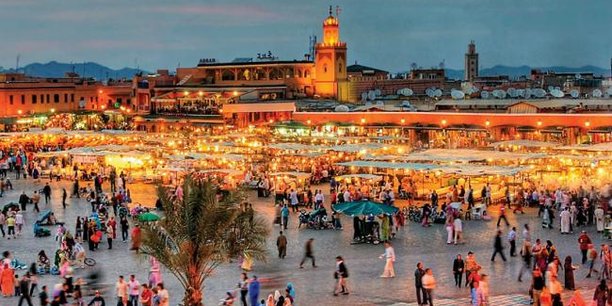
The Sherifian kingdom, which will welcome 26 million annual tourists in 2030, plans to reach 54% this year, with revenues exceeding 100 billion dirhams. A destination that the Al Haouz earthquake did not stop, Morocco is accelerating its strategy. If the authorities say they are “riding a wave of growth”, the profession, for its part, is warning about the informal sector, particularly in Marrakech.
This year, Morocco was the country in the spotlight at the World Travel Market London. It was also the Moroccan Minister of Tourism, Crafts and the Social and Solidarity Economy, Fatim-Zahra Ammor, who kicked off this influential travel and organized tourism meeting organized at the beginning of November, in the British capital. A way for the kingdom to further push its pawns towards the realization of its national strategic plan which targets 26 million annual visitors in 2030. A “playable” objective according to the minister. To achieve it, the authorities are stepping up actions. “This is an exciting time for Morocco’s tourism sector, as we ride a wave of growth under the visionary leadership of His Majesty King Mohammed VI. Our ambition to become a leading destination is gaining momentum,” declared at the end of the London forum, the one who leads the tourism agenda of the Shereef kingdom.
From 2024, the country will be equipped with a Moroccan tourism agency which will arise from the transformation of the current Moroccan National Tourism Office (ONMT), announced Fatim-Zahra Ammor during a recent parliamentary session where she presented the draft sectoral budget for the coming year. Ten new offices will be added to the ten already established throughout the world, particularly in Europe and America. Objective: maximize the promotion of this tourist destination. For the current year already, the kingdom hopes to welcome 14 million tourists and mobilize revenues of 110 billion dirhams, or more than 9 million euros. This would be a first. The 11.1 million visitors welcomed during the first nine months of the year and the October high season marked by school holidays in Europe, as well as the various forums organized in the country (the annual meetings of the IMF and the World Bank, the Africa Investment Forum, etc.) are all elements which give confidence to the authorities and the profession, who have worked hard after the Al Haouz earthquake which occurred on September 8. “Thanks to the royal vision, we were able to quickly recover from the earthquake. This has allowed us to maintain the tourism machine in our country,” says Seloua Berrada, president of the Regional Association of Travel Agencies of Marrakech-Safi. In April 2022, the kingdom launched its new international brand called “Morocco Land of Light”, which emphasizes its wealth and cultural diversity. Objective: “to position the [country] among the most coveted global destinations and strengthen its trendy image, particularly among younger generations of travelers,” explained Adel El Fakir, general director of the ONMT. The campaign had also won an award in France. Currently, the authorities are working to strengthen air traffic. In this sense, the ONMT signs partnerships with operators, as was recently the case with the low-cost airline Transavia. There is also awareness of a necessary increase in reception capacity. “By 2030, we need to have approximately 40,000 additional beds and around 60,000 additional beds by 2030,” the minister declared to Médias 24. All these initiatives are acclaimed by professionals who generally see them as “excellent work” on the part of the government to ensure the influence of a pillar sector of the national economy, which contributes 7% of GDP and which has been deeply affected by the Covid crisis. But for Seloua Berrada, several other aspects deserve drastic treatment. He believes that at a time when Morocco is working to strengthen its attractiveness among developed markets as is the case in Canada or England, air partnerships should more involve the air transport majors. “In Marrakech now, we have 600 flights per week, but 70% are low cost flights. You have to work to have regular flights with Royal Air Maroc to all the country,” he explains. The informal, the other concern of professionals Another reality which worries the profession: the informal. In general, hosting is the area that is often the most criticized in the media. But according to the president of the Association of Marrakech-Safi agencies, almost all sectors of the sector are affected. “Informality is killing us in Marrakech,” denounces Berrada. “We have a magnificent strategy; but we have to attack the informal sector,” he adds, estimating that without this, part of the tourist windfall which will emanate from the African Cup of Nations (CAN) in 2025 and the Football World Cup in 2030 could be eroded by informal actors. In the 2024 finance bill, the authorities intend to tackle the informal sector in general, which they consider to be « a huge burden on the national economy », but the precise actions that will be carried out around tourism are not yet known. Eye on the Atlantic Beyond the nation-national dimension, Morocco wants to add the African regional string to its bow with the draft strategy dedicated to Atlantic tourism called for by King Mohammed VI on November 6 on the occasion of the celebration of the 48th anniversary of the Green March. “The vocation [of this strategy, editor’s note] would be to highlight the many potentialities of the region and, thus, to establish it as a real destination for the practice of seaside and Saharan tourism,” explained the monarch at the time. Very clearly, Morocco is preparing for a tourism boom fueled by all regions of the world. Rabat still has seven years to play all its cards.
source: afrique.latribune.fr