
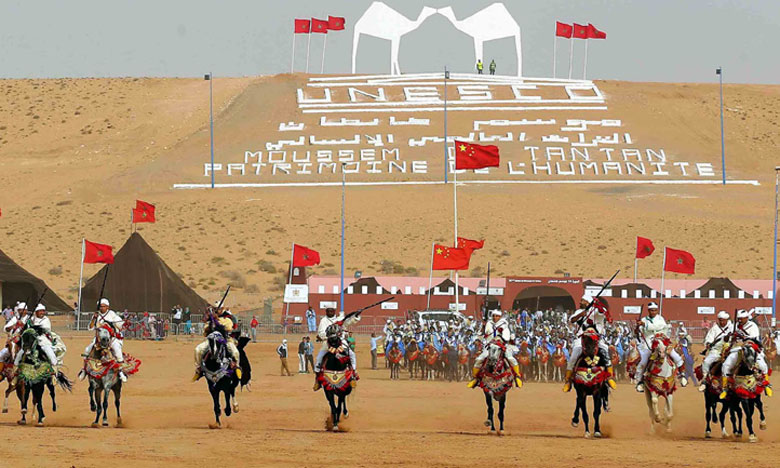
What is Tan Tan moussem used for? The same question was asked in an article that I published in 2009. Eight years later, I ask it again. A naughty spirit would have quickly responded: “nothing”, but that would only be a joke on his part. However, we would be hard-pressed to give him a definitive answer. What is moussem used for? To party and see stars?
Even if the moussem is distinguished from the festival by the fact that it « is a grouping defined in space and time around the celebration of a siyyed », while « the festival is a festive event » (Ziou Ziou, 2016), both are cultural events aimed at promoting heritage or enlivening a heritage site and boosting tourist activity.
The festival or moussem are moments of re-reading the territory which allow the population to reclaim their living space. In Europe, many territories benefit greatly from events (considerable economic advantages) which allows the revitalization of the territory by highlighting its socio-economic assets and its natural and cultural specificities and also makes its localities attractive.
Events are also part of regional planning issues. It participates in the organization and promotion of territories and contributes to promoting the desired image of cities, especially those free of economic assets or advantages linked to their geographical position, and this by seizing the cultural channel.
All this leads us to question the socio-economic effects of Tan Tan moussem. The profitability of such activities is often measured in terms of the economic impact on the city and its region. In the Tan Tan region, profitability is zero, no dynamic is generated by the moussem which will be able to reflect on it. No program is committed. For what?
It is less the presence of heritage and natural assets than the will and imagination of local stakeholders and decision-makers that is decisive. Their personality plays a big role. Festivals and moussems will have no impact if elected officials are not personally invested in cultural projects intended to promote their territories.
The cultural events of European cities would not be as well known if their elected officials were not lovers of culture. The biggest festivals which attract the greatest number of spectators and which arouse the greatest media interest are those from which very competent personalities emerge.
Culture constitutes a major lever for development. There is an approach which considers cultural activities in terms of economic sectors. We can draw inspiration from the approach of heritage economy clusters which aim to use heritage as a lever for economic development. It is sometimes a question of heritage deposits to be exploited.
The development of a territory calls upon the cultural dimension. The impact of cultural activities on the socio-economic development of territories is no longer in doubt. Culture is a dynamic means that serves to take the path of development, to define personalities, to connect people together and to drive progress.
The population of Tan Tan has clearly expressed its wish to highlight the potential and tourist assets of the city as well as its cultural heritage. It is the awareness that to live better, instead of waiting for the benefits of the welfare state, we must draw on local resources and culture. Normally, this should have been the purpose of this mousse… But alas!
If the elected officials of European cities are at the origin of the success of cultural events, our elected officials and decision-makers whose creative incompetence is absolute, on the contrary take advantage of the organization of these events to acquire a certain notoriety or use it for political purposes… Go figure!
The cultural and natural heritage of Tan Tan constitutes a wealth whose development imposes responsibilities on local actors and presupposes a certain degree of competence so that this heritage becomes a determining factor in development. This development should be considered as one of the main aspects of land use planning and local planning.
Different essential questions arise: did the Tan Tan moussem in its 13th edition which took place from May 5 to 10 succeed in its bet? Are there any concrete results? In 2009, the answer was unambiguous and it still is in 2017: negative.
If the moussem constitutes the city’s primary source of advertising ensuring its promotion, however, this « spotlight » does not generate the discovery of tourist places in the hinterland and does not lead to choices for subsequent stays. Worse still, the moussem as a cultural event does not encourage any involvement of residents who can develop new forms of conviviality among themselves and strengthen their civic awareness.
The moussem is supposed to associate music with the tourist discovery of the territory in which the music enlivens the place, and the place allows a particular listening to the music. In Tan Tan, the stars are there and each year, the media coverage of these presences takes up a little more space. We prefer known headliners from abroad or nationals who come to fill their pockets, because the main thing is to fill the arenas in a city where the state of infrastructure and basic services (hospitals, roads, lighting, green spaces, etc.) is pitiful.
According to the Almouggar Foundation, which is responsible for preserving and promoting the Moussem of Tan Tan, the latter “aims to contribute to the preservation and enhancement of the cultural heritage of Saharan Morocco made up of the Hassani heritage, a fundamental component of Moroccan identity”. A speech which contrasts with the cultural void and the absence of any structure allowing the promotion of local culture (museum, media library, etc.).
So why are we unable to promote our tangible and intangible heritage, while putting them at the service of the economic, social and cultural renaissance of the city? Is it because civil society has not yet reached the degree of maturity allowing it to understand the stakes of such an event? Or because local elected officials and decision-makers have neither the experience nor the level required to organize an event of this magnitude and are poorly trained in territorial diagnosis methods? It is appropriate here to point the finger at bad governance, incompetence and amateurism as responsible for this failure.
Once again, Tan Tan has missed a dream opportunity to reconnect with development, while the success of the moussem can generate a whole myriad of actions in favor of the territory, relaunch tourist activity and boost this destination, especially since the moussem is listed as a world heritage site. This recognition by UNESCO is a plus for the visibility of the city and constitutes a territorial marketing argument which can bring a lot to Tan Tan, this city whose name is associated with the problem of the Moroccan Sahara which has turned the geopolitical environment upside down. In fact, it was in this small town that the embryonic Polisario Front movement saw the light of day in the 1970s, initiated by a group of students from the town.
As a child of this city myself, I can only testify to the enormous frustration and disappointment of the local population in the face of the negative impact of this event which is beginning to tire. The moussem is a double-edged sword, either it contributes to the socio-economic development of the city, or it continues to exacerbate frustrations through its failure. But it is never too late to make this failure a springboard and not a disaster and transform it into an experience and then into success, unless the aim of the moussem is other than socio-economic development.
In his article published in the New York Times on September 7, 2008, A. O. Scott rephrased the initial question: it is not a question of knowing « what are festivals for », but « who are they for? » This is the key.
source: huffpostmaghreb