
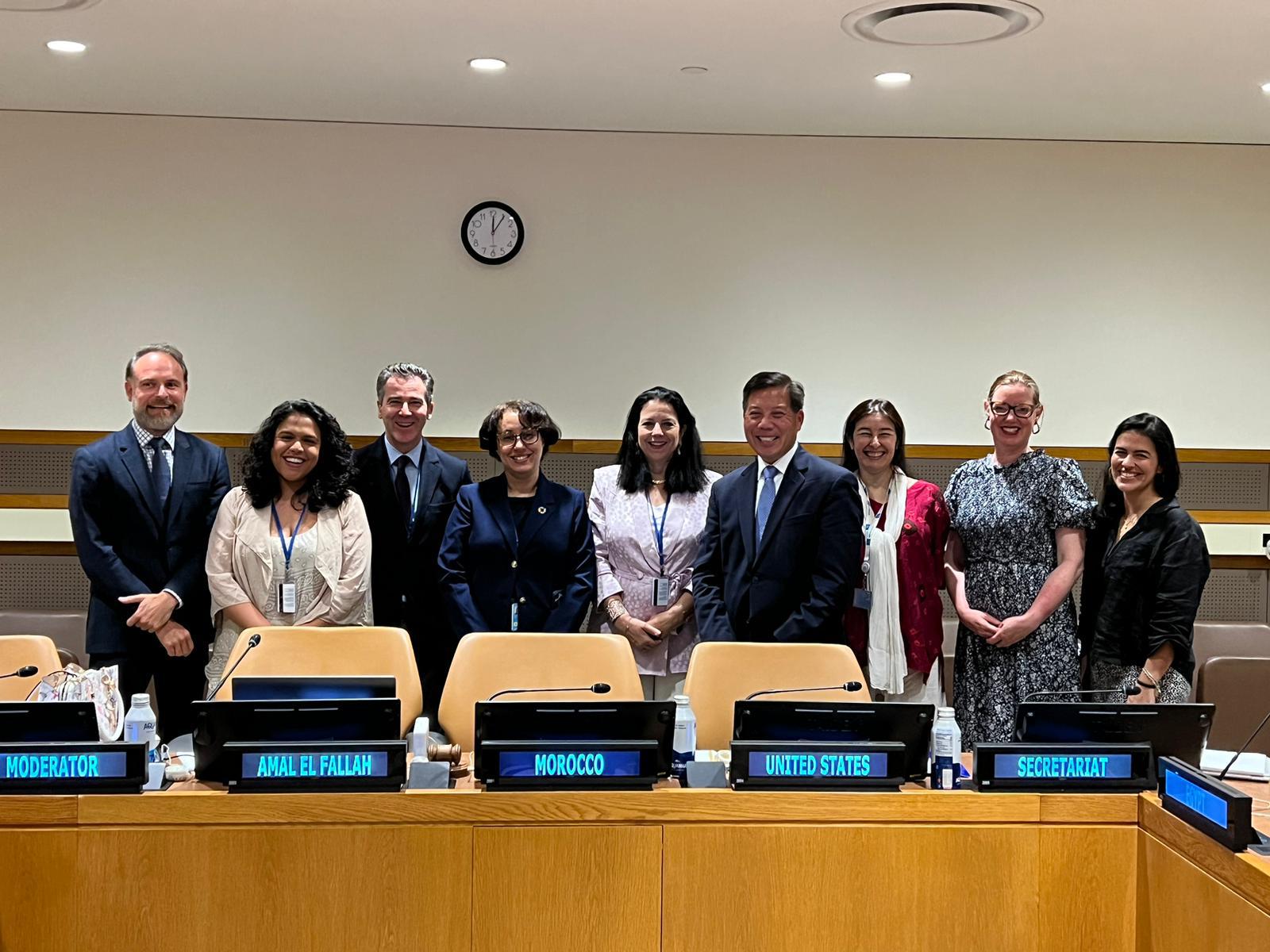
The Group of Friends of Artificial Intelligence for Sustainable Development, co-chaired by Morocco and the United States, held a high-level meeting on Monday in New York to explore the opportunities that artificial intelligence (AI) offers to sustainable development in Africa.
Place under the theme “Artificial Intelligence: An exponential opportunity for sustainable development in Africa”, this initiative illustrates Morocco’s firm commitment to South-South cooperation, a strategic pillar of the Kingdom’s foreign policy under the leadership enlightened by King Mohammed VI. The objective of this meeting is to highlight the importance of strategic partnerships and enhanced cooperation to improve African capabilities in AI and give the continent a voice in the global debate on this technology, its governance and its benefits. The event welcomed Professor Amal El Fallah Seghrouchni, Executive President of the International Center for Artificial Intelligence of Morocco, also known as Ai movement, based at the Mohammed VI Polytechnic University (UM6P). She presented an in-depth analysis of the central role of AI in transforming Africa’s future, highlighting that this technology could contribute up to $1.5 trillion to the African economy, or 6% of the continent’s GDP. “Whether it is to improve healthcare, agricultural productivity, promote educational inclusion or stimulate economic growth, AI has already proven to be a powerful catalyst for sustainable development,” she said. She also addressed issues of integrating technological and regulatory requirements for ethical and responsible innovation, advocating for trustworthy AI. To fully exploit the potential of AI, Africa must accelerate its technological development and define a concrete roadmap including investments in infrastructure, improving data quality, education, capacity building, research and innovation, as well as AI governance, she added. She recalled that last June, Morocco organized in Rabat the first high-level Forum on artificial intelligence in Africa, bringing together more than 20 countries, leading to the unanimous adoption of the Rabat African Consensus on Artificial Intelligence. The International Center for Artificial Intelligence of Morocco (Ai Movement) positions itself as a regional research and development center and leader in the field of AI, working for trustworthy AI on a continent-wide scale. This center was recognized as a UNESCO Category II center in November 2023, making it a center of excellence in AI and data sciences in Africa. This event at the UN also aimed to give greater visibility to the Rabat African Consensus on AI and to contribute to better representation of the continent in global discussions on the governance of this technology. The Consensus calls for the establishment of an African strategy on AI governance, with a focus on infrastructure, training, research funding and technological development, as well as data protection. Professor El Fallah Seghrouchni highlighted the importance of developing reliable AI technologies, taking into account ethical considerations, fairness, transparency and accountability. “By focusing on responsible AI development, we can maximize benefits while minimizing potential risks,” she insisted. The meeting also welcomed Dr. Rachel Adams, CEO of the Global Center on AI Governance based in South Africa, which hosts the African Observatory on Responsible AI. Dr. Adams highlighted the Observatory’s missions, which consist of collecting data and proposing strategies to improve AI governance. Ms. Majda Moutchou and Mr. Chris Lu, deputy representatives of the Permanent Missions of Morocco and the United States to the United Nations, welcomed the inclusive discussions of the Group of Friends on AI aimed at promoting this technology for sustainable development and reducing the digital divide. They expressed their satisfaction with the positive impact of AI in Africa and the development prospects it offers with the support of international partners. The Rabat Consensus, adopted unanimously, sets three fundamental principles for mobilizing African institutions: developing a common framework for global AI governance, using AI in the public sector for the common African good, and guaranteeing ethical and human rights-respecting development of this technology.