
As geopolitical tensions disrupt major traditional trade routes, a new corridor is emerging in the north of the planet. From the Arctic to the Atlantic, via Dakhla in Morocco, a silent revolution is underway: rethinking global trade in the era of global warming.
A shorter route, a more uncertain world For centuries, maritime trade has relied on two vital arteries: the Suez Canal and the Panama Canal. Today, the stability of these passages is no longer guaranteed. The blocking of the Suez Canal in March 2021 by the Ever Given revealed the extreme fragility of these bottlenecks.
Faced with this observation, the Northern Maritime Route (NMR), running along the Russian Arctic coasts, appears to be a strategic alternative. According to the organization Armateurs de France (2020), the RMN would make it possible to reduce the distance between Europe and Asia by 40% compared to traditional routes.
By 2050, experts predict annual accessibility without icebreaking ships, a direct consequence of the accelerated melting of polar ice.
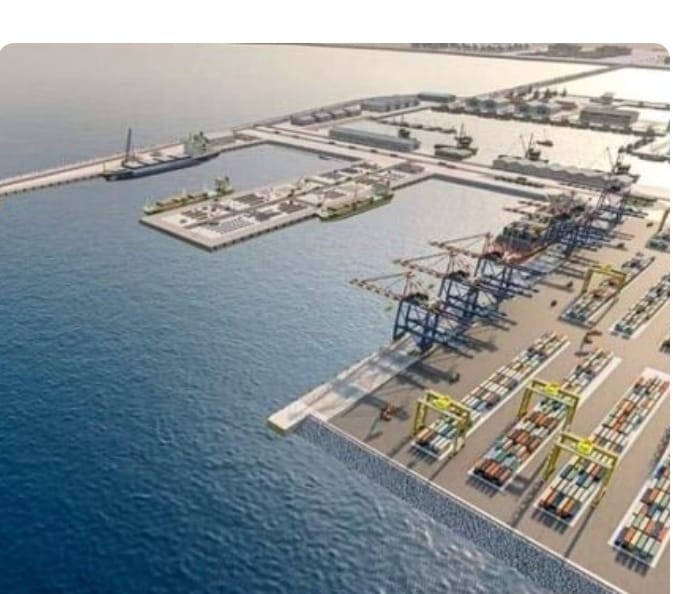
Dakhla Atlantique, at the heart of the new South-North corridor Several thousand kilometers from the Polar Circle, another project is taking shape. The port of Dakhla Atlantique, on the southern Moroccan coast, aims to become a strategic logistics hub connecting Africa, Latin America, and Europe.
Positioned at the crossroads of the South-North and East-West routes, Dakhla Atlantique could offer BRICS+ countries – now including Egypt, Ethiopia and Saudi Arabia – a credible alternative to secure their exports.
According to a comparative analysis of maritime distances (SeaRoutes.com, 2023), the port of Dakhla could constitute a strategic logistics stopover for flows between Asia and Latin America, or between Africa and Europe, in addition to the route via Suez.
For certain South-South connections, such as Shanghai–Dakhla–Santos (Brazil), the route via the Atlantic could prove to be shorter and more stable than passage through Suez followed by transit to Latin America.
Behind this ambitious project, a complex set of alliances is emerging. For a decade, China has deployed a strategy of global expansion through its flagship Belt and Road Initiative (BRI). By increasing investments in infrastructure in Africa and Eurasia – ports, railways, special economic zones – Beijing seeks to secure its supplies, open new markets and strengthen its geopolitical influence. The construction of new logistics corridors, particularly in West Africa, is part of this long-term South-South integration logic.
At the same time, Russia is betting on the Northern Maritime Route (NMR) to circumvent Western sanctions which limit its access to traditional European markets. By capitalizing on the commercial potential of the Arctic, Moscow hopes to diversify its export routes of hydrocarbons, minerals and grains, while strengthening its links with Asia. The RMN has become for the Kremlin an economic lever that is as strategic as it is symbolic: it embodies resilience in the face of the isolation imposed by Western powers.
At the crossroads of these two ambitions lies Morocco, whose political stability, economic modernization and proactive diplomacy towards sub-Saharan Africa make it a natural strategic partner. Through the Dakhla Atlantique port project, Rabat is clearly displaying its intentions: to become a major logistics player linking Africa to global trade flows, while consolidating its n role as a hub between Europe, Latin America and emerging Asia.
The convergence of Chinese, Russian and Moroccan interests around this new transcontinental corridor thus reveals a silent shift in global commercial logic. Where yesterday trade was polarized around the main traditional North-South axes, today new multipolar networks are emerging, supported by pragmatic alliances between emerging powers.
The future of world trade is in motion Faced with the multiplication of logistical, economic and climatic crises, the traditional model of maritime trade is undergoing profound restructuring. The blockage of the Suez Canal, the restrictions imposed on the Panama Canal by drought, and the growing tensions in certain strategic regions have revealed the fragility of a system based on a few oversaturated corridors. The globalization of tomorrow will have to rely on routes that are more diversified, more resilient and less vulnerable to geopolitical and environmental hazards.
In this context, the Northern Maritime Route (NMR) and the Dakhla Atlantic port project stand out as credible alternatives. By connecting Asian, African and European resources via paths less exposed to traditional tensions, these infrastructures could offer greater fluidity to global trade. The RMN, by shortening the maritime distances between Asia and Europe by 30 to 40%, and Dakhla Atlantic, by establishing itself as a strategic hub for South-South flows, could play a determining role in the remodeling of major trade routes.
However, the success of this restructuring will depend on the ability to overcome major technical, economic and environmental challenges. In the Arctic, it will be necessary to guarantee secure navigation without threatening fragile ecosystems. In Morocco, the completion and modernization of infrastructure around Dakhla will require sustained investments and exemplary logistics governance. Added to this is the imperative of energy transition: the development of these new routes can only be achieved at the cost of sustainable innovations, limiting carbon emissions from maritime transport.
Ultimately, the future of world trade rests on a delicate alchemy between geopolitical pragmatism and environmental responsibility. To become established, new roads will have to respond to immediate economic needs while integrating growing ecological constraints. If this balance is achieved, the RMN and Dakhla Atlantique could symbolize a new era of international exchanges, more fluid, more balanced, and more respectful of the global issues of the 21st century.
by Younes Bennane