

Morocco has significant potential in terms of the tourist landscape. The geographical position of the kingdom means that it offers different tourist offers, able to meet different needs (sea, mountains, countryside, etc.). In addition, according to data from Industry Research, the southern provinces will be put forward in terms of the development of this vital economic sector by 2024.
King Mohammed VI took stock of the situation and displayed the kingdom’s ambitions to develop the southern provinces in the same vein as the rest of the country.
Indeed, the southern provinces, despite the wealth they abound, remain lagging behind other regions of the kingdom, due to the fact that investments are made there at a “slow” pace, in addition to the lack of infrastructure, particularly transport, both land and air.
It is in this sense that the king indicated in his speech on November 6, on the occasion of the 44th anniversary of the Green March, that the establishment of a railway line linking Marrakech and Agadir “will constitute an essential lever for the creation of numerous jobs, not only in the Souss region, but also in all areas neighboring.”
This should make the region “an economic hub linking the northern and southern parts of Morocco, by operating the junction between Tangier in the north and Oujda in the east on the one hand, and our Saharan provinces on the other hand ”, added the Sovereign, noting that “this orientation is part of the framework of advanced regionalization, designed in the spirit of an equitable distribution of wealth between the regions of the kingdom.”
Tourist development in the South, a priority
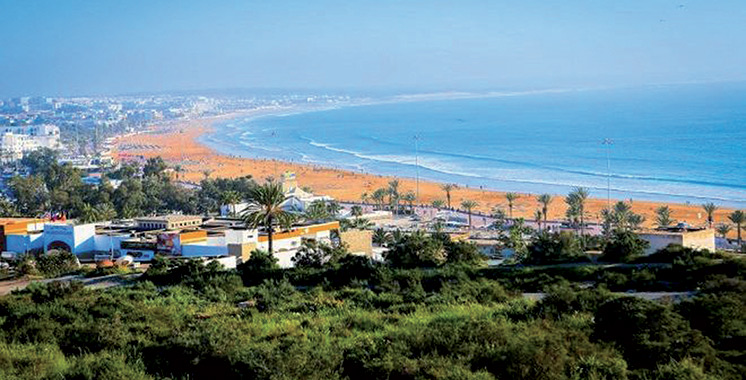
The southern regions have significant tourist potential, particularly with regard to the tourist niche of hiking in the desert, but also beaches greatly appreciated by world-renowned surfers.
However, the realization of this project will not happen overnight, because it requires many studies and the mobilization of significant technical, material and human resources. Thus, Mohamed Rabie Khlie, Director General of the National Railway Office, explained during the celebration of the 1st anniversary of the high-speed line (Al Boraq) that it would be necessary to dig into the Atlas Mountains to install rails, and that this is not easy, due to the fact that there is no margin for error in such a construction site.
It is in this sense that the kingdom has also called on global experts in the field of railways, notably China, to help it in the realization and modernization of its railway network. In addition, Morocco aspires to bring tourist activity in the southern regions to the same level as that of the north, in accordance with the provisions of the Azur 2020 plan, initiated by the kingdom in 2001, and whose objective was to increase the number of tourist arrivals to 10 million in 2013, through the establishment of 6 seaside resorts (including 5 on the Atlantic coast and 1 on the Mediterranean side).
The development of the South’s tourism offering is therefore an entirely achievable objective, to the extent that the kingdom already has the necessary assets to do so. Thus, Morocco has succeeded in attracting big names in the hotel industry, including Accor, Hilton, Sofitel, Four Seasons and Radisson, which should complement the land and air link project in these regions. By taking advantage of the tax advantages offered to them, they should contribute to the economic development of the south through the creation of several jobs, in addition to attracting a diversified supply of tourists to the kingdom, which obviously represents foreign currency income.
Morocco, a first-rate tourist El Dorado in Africa
The tourism sector generated around 70 billion dirhams in 2017, greatly supporting the national GDP. This was also maintained at a “correct” level thanks to the contribution of tourist activity (and Industry) in 2018, and we expect this to continue at the end of 2019, two periods which suffered from a decline in agricultural activity.
Thus, data from the Industry Research report indicates that 12.3 million tourists chose Morocco to spend their vacations, a figure up 7% compared to 2017. Likewise, tourist arrivals amounted to 11.3 million during the first 11 months of 2018, which is equivalent to 1 million tourists per month. Note that the kingdom recorded a 6% increase in arrivals over a period of 10 years (2000-2018).
As for the most “in demand” destinations during the said period, Marrakech comes out on top with 2.4 million arrivals recorded between January and November 2018, for a total of 2.6 million overnight stays in the city’s various establishments. The ocher city is followed by Agadir with 1.03 million arrivals during the first 11 months of 2018, an increase of 13% compared to 2017, while Essaouira saw its arrivals increase by 15% at the end of October of the same year.
In terms of nationality, it is on the Chinese side that we find the most important evolution. Indeed, visitors from the Middle Kingdom have exploded in the space of 3 years, going from 10,000 in 2015 to 180,000 in 2018. Arrivals from Asia are particularly on the rise, notably from Japan (+39%), but not only that, since Brazilians are indeed interested in Moroccan products, but the kingdom itself (+38%). Arrivals of American tourists increased by 29% during the said period, while “classic” destinations, particularly from our European neighbors, maintained a good level. Thus, arrivals from Germany increased by 15%, by 9% for Italy and the Netherlands, and by 8% for France and Spain.
Moreover, according to data from the Travel Risk Map, the kingdom is positioned at the same security level (low risk) as the majority of European countries, the USA and Canada. Morocco would have managed to maintain this position over the last 3 years.
For comparison, other countries in the North African region, notably Egypt, Algeria and Tunisia, are in the box of “medium risk” zones for tourists, due to the political instability and extremist currents that hover over these regions.
source: hespress.com