
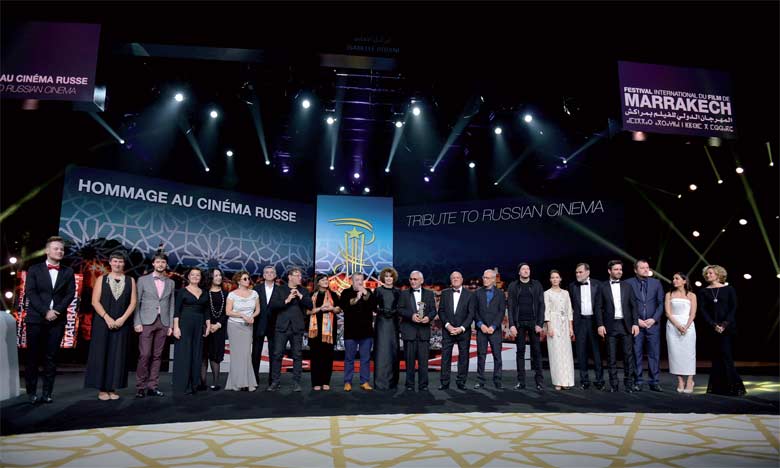
As part of its sixteenth edition, the Marrakech International Film Festival is pleased to pay tribute to Russian cinema, one of the richest and most prolific in Europe. From the United Kingdom to Japan, via Scandinavia and Canada last year, the Marrakech International Film Festival has always wanted to highlight cinematography in order to reinscribe new works in the context in which they were born. This year, Russia will therefore be in the spotlight, Russian cinema – pre-revolutionary, Soviet or post-Perestroika – being one of the major players in world cinema since its very beginnings. If, over the last twenty-five years, Russian cinema has redefined itself, great works have nevertheless seen the light of day, new names have come to succeed the great classics and the major festivals are always on the lookout for those who tomorrow will take over from the directors to whom Marrakech will pay homage. From Sergei Eisenstein and his Battleship Potemkin to Andreï Zvyagintsev’s Leviathan, the festival will span eighty years of cinematography which has alternated genres: the Great History (Ivan the Terrible by Sergei Eisenstein, Andreï Rublev by Andreï Tarkovsky, Siberias by Andrei Konchalovsky, The Russian Ark by Alexander Sokurov), wars and their consequences. traumas (When the Storks Fly by Mikhail Kalatozov, The Forty-first by Grigori Tchoukhraï, The Brother by Alexei Balabanov, The Prisoner of the Caucasus by Sergei Bodrov), comedies (The Radiant Way by Grigori Alexandrov, The Zazous by Valeri Todorovski), social problems (I am twenty years old by Marlen Khoutsiev, Little Vera by Vassili Pitchoul, Move not die and resuscitate by Vitali Kanevski, Taxi Blues by Pavel Lounguine, The Idiot! by Yuri Bykov), questioning (The Theme by Gleb Panfilov, The Sacrifice by Andreï Tarkovsky)… and even love (Of Love by Anna Melikian)! The Marrakech festival has already awarded two Grand Prizes to Russian films (Wild Field by Mikhaïl Kalatozichvili, 2008; Classe à part by Ivan Tverdovski, 2014), paid tribute to Andrei Konchalovsky, invited Pavel Lounguine to the jury, not to mention the numerous works which punctuated the selections of this event. It was natural that the tribute was paid to the entire cinematography: 30 films accompanied by a delegation of 30 guests (directors, actors and actresses, cinematographers, screenwriters, institutions, producers, etc.) chaired by the director and president of Mosfilm, Karen Chakhnazarov.